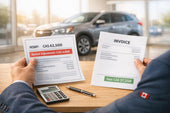
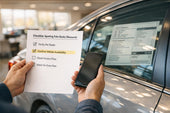
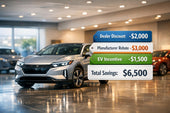
When buying a car in Canada, the price you see isn't the price you'll pay. Dealer fees, taxes, and other charges can significantly increase your total cost. Here's what you need to know to avoid surprises:
- Mandatory Fees: These include federal GST (5%), provincial sales taxes, a $100 air conditioning tax, and registration fees ($50–$300). These are non-negotiable.
- Dealer-Imposed Fees: Documentation fees ($500–$800), freight and pre-delivery inspection (PDI) fees ($1,700–$2,500), and optional add-ons like rustproofing or extended warranties. Many of these are negotiable.
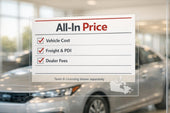
- Provincial Differences: Taxes and regulations vary. For example, Alberta only charges 5% GST, while Ontario has a 13% HST. Some provinces enforce "all-in pricing", meaning advertised prices must include mandatory fees.
- Negotiation Tips: Ask for reductions on admin fees and optional add-ons. Decline unnecessary extras like nitrogen-filled tires or VIN etching.
To avoid overpaying, always request a detailed breakdown of costs and focus on negotiable fees. Understanding these charges can save you thousands on your next vehicle purchase.
Are Car Dealers Allowed To Charge Fees? | Ontario Used Car Sales | All-In Pricing
Mandatory Fees and Government Charges
When purchasing a car from a dealership in Canada, some fees are unavoidable. These mandatory charges apply to everyone and are non-negotiable.
Federal GST and Air Conditioner Excise Tax
Every new vehicle purchase comes with a 5% federal Goods and Services Tax (GST) applied to the vehicle's price. Additionally, if your car is equipped with air conditioning - which is standard in most modern vehicles - you’ll need to pay a flat $100 Air Conditioning Excise Tax. This tax has been in place for years and is consistent across all provinces and territories.
For high-end vehicles, a federal luxury tax may apply. This tax is calculated as the lesser of 10% of the total vehicle price or 20% of the amount exceeding $100,000.
Provincial Sales Tax Differences
Sales tax rates vary depending on where you register your car. Five provinces use a Harmonized Sales Tax (HST), which combines the federal GST with provincial tax into a single rate:
- Ontario: 13%
- New Brunswick: 15%
- Prince Edward Island: 15%
- Newfoundland and Labrador: 15%
- Nova Scotia: 14% (effective 1 April 2025).
In provinces without HST, the 5% GST is charged alongside a separate provincial tax. For example:
- British Columbia: A tiered PST applies, starting at 7% for vehicles under $55,000 and climbing to 20% for those priced at $150,000 or more. Combined taxes range from 12% to 25%.
- Saskatchewan: A total of 11% (5% GST + 6% PST).
- Manitoba: A total of 12% (5% GST + 7% RST).
- Quebec: A total of 14.975% (5% GST + 9.975% QST).
Meanwhile, Alberta, Yukon, Northwest Territories, and Nunavut only charge the 5% GST, with no additional provincial tax.
"The value of your trade-in will also be applied directly to the transaction before sales taxes are calculated. This means you'll be charged sales tax only on the remaining balance", says Stephanie Wallcraft, a professional automotive journalist.
On top of these taxes, buyers must also cover registration and licensing fees.
Registration and Licensing Fees
Before hitting the road, your new vehicle must be registered and licensed with your provincial government. These mandatory fees typically range from $50 to $300 across Canada. For instance, in Ontario, a vehicle permit costs $32, while a combined plate and permit is $59.
Most dealerships will handle the registration and licensing process for you. The fees they charge for this service usually align with the official rates set by provincial authorities. However, it’s a good idea to double-check your invoice to ensure no extra charges have been added.
Common Dealership Fees
When buying a car, the listed price is just the starting point. Dealerships often add their own fees on top of government-mandated charges, which can significantly increase the final cost. These additional fees can range from $2,200 to $3,300, so it’s important to understand what you’re paying for. Here’s a breakdown of the two main types of dealership fees.
Documentation and Administration Fees
Documentation fees cover the cost of preparing paperwork and handling registrations. In Canada, these fees usually fall between $500 and $800, but in areas without fee limits, they can climb above $1,250. Unlike government charges, these fees are set by the dealership and are often negotiable. Many dealers are open to reducing or even waiving them during negotiations.
It’s also worth keeping an eye out for market adjustment fees, which are additional charges applied during periods of high demand. These, too, are typically negotiable. Another fee to watch for is in-house advertising fees. Sometimes, dealers add these on top of the regional advertising fees already included in the factory invoice. Being aware of these charges can help you cut down on unnecessary expenses.
Freight and Pre-Delivery Inspection Fees
Freight and PDI (Pre-Delivery Inspection) fees are typically the largest single item on your invoice, ranging from $1,700 to $2,500. These fees cover two main costs: shipping the car from the factory to the dealership and preparing it for delivery. As Stephanie Wallcraft explains:
"PDI stands for pre-delivery inspection, which is the labour cost of the mechanics and detailers who inspect the car after it arrives and get it ready for you to pick up. Essentially, this fee is how the dealership passes these shipping and preparation costs on to you."
Unlike documentation fees, Freight and PDI charges are generally non-negotiable. Manufacturers set these costs, and they are consistent across Canada, meaning everyone pays the same amount for a specific model, regardless of how close they are to the factory. These fees only apply to new vehicles and are not charged when purchasing used cars.
In provinces like British Columbia, Alberta, Manitoba, Ontario, and Quebec, laws require dealerships to include Freight and PDI fees in the advertised price. This means the sticker price already accounts for these costs, so there shouldn’t be any surprises when reviewing your invoice. Knowing these details can help you better navigate the car-buying process and avoid unnecessary charges.
Optional and Hidden Fees
When buying a car, it's not just the sticker price you need to consider - additional fees can creep in and inflate your total cost. Some of these are legitimate government-mandated charges, while others are optional dealer add-ons that you can choose to decline. Knowing the difference can save you money and frustration.
Environmental and Tire Recycling Fees
One common charge to look out for is the tire recycling levy, a government-mandated fee that typically ranges from $20 to $30 per vehicle. This fee helps cover the cost of properly disposing of old tires when new ones are installed. However, this charge only applies if the vehicle comes with brand-new tires. If you're purchasing a used car with existing tires, this fee should not appear on your invoice.
Motor Vehicle Regulator Fees
In addition to environmental levies, there are small regulatory fees imposed by provincial authorities. For example, in Ontario, there's an OMVIC transaction fee of $22.00, effective September 1, 2025. Meanwhile, Alberta applies an AMVIC levy of $10.00. These charges fund organizations responsible for overseeing dealership operations and addressing consumer complaints. While these fees are mandatory, they are relatively minor compared to other costs.
That said, be cautious of fees that are presented as official but aren't legally required. Terms like "dealer prep fees" or "market adjustment fees" might sound legitimate, but they are often just ways for dealerships to pad their profits. As Matthew Taylor from Loans Canada explains:
"Many car buyers have raised concerns about potential hidden fees that dealerships may add to the advertised price, which can significantly increase the overall cost of a vehicle".
To protect yourself, always ask for clarification. Request a detailed breakdown of all charges and confirm which ones are legally mandated versus dealership-imposed. If something doesn’t add up, don’t hesitate to ask questions before you commit to signing.
Provincial Differences in Dealer Fees
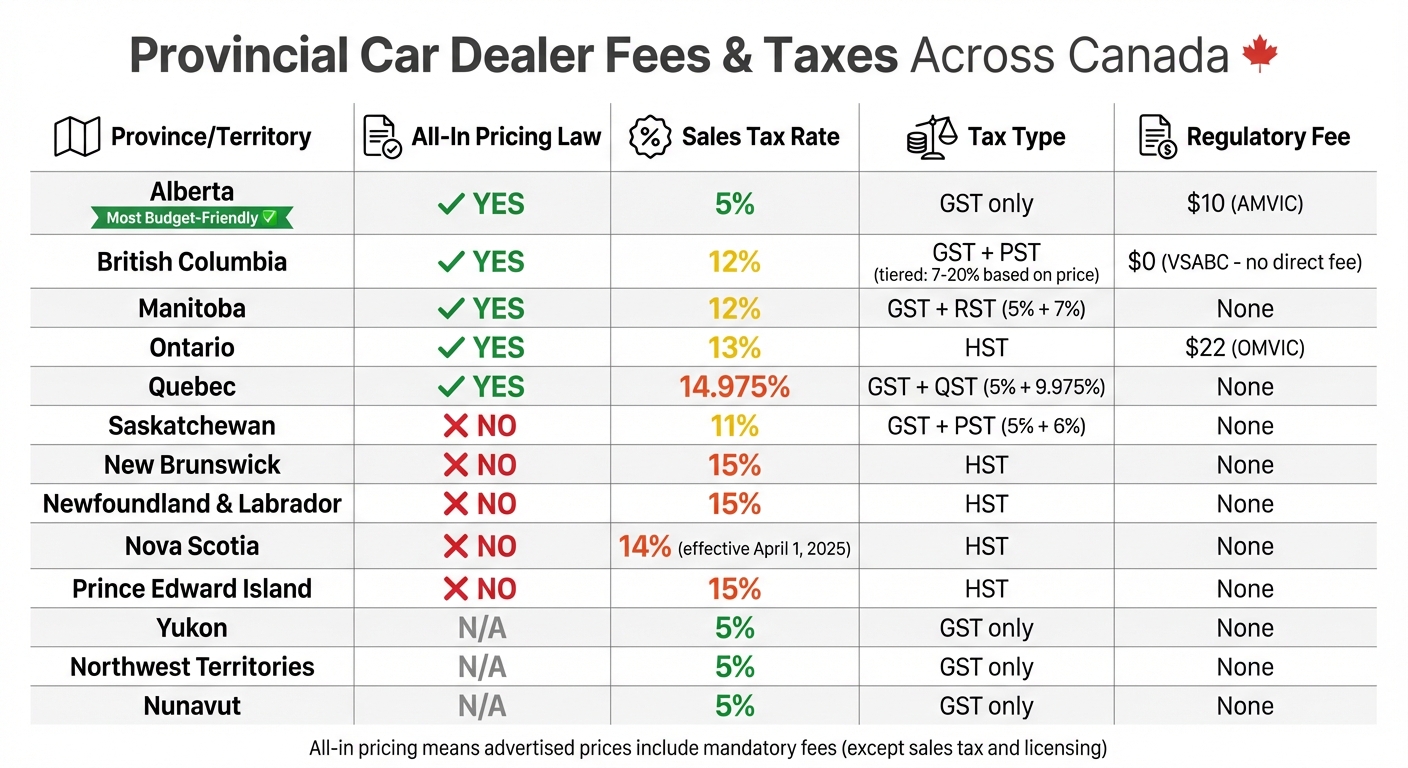
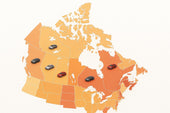
Provincial Car Dealer Fees and Taxes Comparison Across Canada
Dealer fees can vary significantly across provinces, and understanding these differences is key to calculating the total cost of buying a vehicle. Beyond the mandatory fees and dealer-imposed charges already discussed, provincial rules play a major role in shaping your final bill.
Take sales tax, for example. It ranges from 5% in Alberta to 15% in the Atlantic provinces. For a $40,000 vehicle, this means taxes alone can add anywhere from $2,000 to $6,000 to your purchase cost.
Provincial regulations also differ when it comes to dealer fee disclosure and advertising. In British Columbia, Alberta, Manitoba, Ontario, and Quebec, all-in pricing laws are in place. These laws ensure that the advertised price includes all mandatory fees, except for sales tax and licensing. This makes it easier for buyers to understand the actual cost upfront.
Only three provinces have oversight fees tied to dedicated motor vehicle regulators. Ontario's OMVIC fee is $22.00 (effective September 1, 2025), while Alberta's AMVIC fee is $10. In British Columbia, the VSABC oversees motor vehicle sales, but buyers aren’t directly charged a fee. Other provinces don’t impose any regulatory fees.
Here’s how these differences stack up across Canada:
| Province | All-In Pricing Law | Sales Tax (GST/HST/PST) | Regulatory Fee |
|---|---|---|---|
| Alberta | Yes | 5% | $10 (AMVIC) |
| Ontario | Yes | 13% | $22.00 (OMVIC) |
| British Columbia | Yes | 12% | $0 (VSABC – no direct buyer fee) |
| Quebec | Yes | 14.975% | None |
| Manitoba | Yes | 12% | None |
| Saskatchewan | No | 11% | None |
| Atlantic Provinces | No | 15% | None |
Alberta stands out as the most budget-friendly province, with only a 5% GST and no additional provincial sales taxes. However, if you’re buying a car from out of province, keep in mind you might face extra costs like safety inspections and registration fees.
Up next, let’s dive into strategies to help you negotiate and cut down on these fees.
sbb-itb-20f5d75
Which Fees Can Be Negotiated
When it comes to car purchases, some fees are open to negotiation, and knowing which ones can be reduced might save you a significant amount of money. Here's a closer look at the fees you can challenge and how to approach them.
Administration and documentation fees are often flexible. Dealers frequently use these fees as a bargaining chip to close a deal. If you're negotiating the final price, ask for this fee to be reduced or even waived entirely as part of your agreement.
Optional add-ons are a notable profit area for dealerships. Items like nitrogen-filled tires ($50–$200), VIN etching ($200–$400), and rust or paint protection packages ($500–$1,000+) can often be removed from your invoice. For example, a DIY VIN etching kit costs only $20–$30, and third-party providers typically offer rustproofing and paint protection at much lower prices than dealerships.
Extended warranties and insurance products can also be negotiated. The average cost of an extended warranty is $1,200, yet 55% of owners never use them. These products can often be purchased later, and third-party providers may offer better rates or terms.
Here’s a quick breakdown of negotiable versus non-negotiable fees:
| Fee Type | Typical Cost | Negotiable? | Strategy |
|---|---|---|---|
| Admin/Doc Fee | $500 – $800 | Yes | Request a reduction or waiver; this is often pure dealer profit. |
| Nitrogen Tires | $50 – $200 | Yes | Decline; regular air is sufficient for most drivers. |
| VIN Etching | $200 – $400 | Yes | Decline; opt for a DIY kit costing $20–$30 instead. |
| Rust/Paint Protection | $500 – $1,000+ | Yes | Decline; third-party providers can do this for less. |
| Extended Warranty | $1,200 – $3,000+ | Yes | Optional; decide based on your vehicle’s reliability and personal needs. |
| Freight & PDI | $1,500 – $2,500+ | Rarely | Usually mandatory for new cars; double-check the manufacturer’s pricing. |
| Air Conditioning Tax | $100 | No | A mandatory federal tax on vehicles with A/C. |
| Tire Levy | $20 – $30 | No | A required provincial fee for new tires. |
Timing can also play a role in negotiations. Dealerships are often more willing to waive fees at the end of financial quarters (March, June, September, December) as they push to meet sales targets. Shopping during these periods can give you extra leverage to strike a better deal.
Total Cost Breakdown Example
Understanding how fees add up can make a big difference when budgeting for a new vehicle. Let’s take a closer look at an example. Say you’re eyeing a car with a $35,000.00 MSRP. To that, you’ll need to add $1,995.00 for Freight & PDI, $599.00 for the admin fee, $100.00 for air tax, $25.00 for the tire recycling fee, and $10.00 for the OMVIC fee. That gives you a pre-tax subtotal of $37,729.00.
Now, factor in the 13% HST, which tacks on $4,904.77. Add another $150.00 for licensing and plates, and your final price comes to $42,783.77. That’s nearly $7,800 more than the sticker price.
Here’s a detailed breakdown:
| Item | Estimated Cost | Type |
|---|---|---|
| MSRP (Base Vehicle Price) | $35,000.00 | Base Price |
| Freight & PDI | $1,995.00 | Mandatory (Manufacturer) |
| Dealer Admin/Doc Fee | $599.00 | Negotiable (Dealer) |
| Federal Air Tax | $100.00 | Mandatory (Government) |
| Tire Recycling Fee | $25.00 | Mandatory (Provincial) |
| OMVIC Regulatory Fee | $10.00 | Mandatory (Provincial) |
| Subtotal (Pre-Tax) | $37,729.00 | |
| HST (13% in Ontario) | $4,904.77 | Mandatory (Government) |
| Licensing & Plates | $150.00 | Mandatory (Government) |
| Total Final Price | $42,783.77 |
This example highlights the difference between the advertised price and the final cost you’ll actually pay. If you live in provinces with a higher HST rate, like Nova Scotia, New Brunswick, or Newfoundland and Labrador (where HST is 15%), your total cost will climb even higher. Always request a full cost breakdown before signing any agreements - it’s the best way to avoid surprises.
How to Reduce Dealer Fees
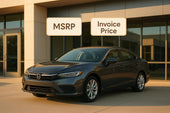
Once you've identified which dealer fees are negotiable, the next step is figuring out how to actually lower them. By using transparent pricing data and pre-negotiated offers, you can shift the conversation from inflated sticker prices (MSRP) to a fair, invoice-based deal.
Using Invoice Pricing Reports
Invoice pricing reports give you a clear picture of the dealer's actual cost. With this knowledge, you can offer a reasonable 3–5% profit margin on top of the invoice price. This approach helps you distinguish between necessary costs - like freight, PDI, and mandatory taxes - and unnecessary dealer add-ons. On average, dealers in Canada make about an 8.7% profit on new car sales, so this method ensures they earn a fair return while giving you the chance to save a significant amount.
Armed with an invoice report, you can confidently question any fees that seem out of line with the manufacturer's costs.
Getting Pre-Negotiated Prices
If you'd rather skip the back-and-forth of negotiating, pre-negotiated pricing is a great alternative. Services like Price Driven provide pre-negotiated deals for a one-time fee of $99.00. These deals guarantee transparent terms and eliminate the stress of haggling. Plus, you can start with their free discount reports to compare dealer-level pricing and MSRP before committing.
With pre-negotiated offers, you’ll know exactly what you’re paying before you even visit the dealership. The terms are set, and the dealer has already agreed, making the buying process much smoother.
Conclusion
Knowing the ins and outs of dealer fees can make a big difference when you're buying a car in Canada. While some fees - like federal air taxes and freight/PDI charges - are non-negotiable, others, such as documentation fees or optional add-ons, often leave room for negotiation.
"If a dealership presents any [optional add-ons] to you as being mandatory to complete a sale, don't hesitate to push back or walk away." – Stephanie Wallcraft, Automotive Journalist
Understanding these fee structures puts you in a stronger position to negotiate. Plus, all-in pricing laws in many provinces ensure that advertised prices already include mandatory fees, helping you avoid surprises at the dealership.
FAQs
How do dealer fees differ across provinces in Canada?
Dealer fees across Canada differ depending on provincial regulations and dealership practices. For instance, Ontario includes a mandatory OMVIC fee of $12.50, while Alberta has an AMVIC fee of $10. Additionally, licensing and registration fees are required in every province, though the exact amounts may vary.
In provinces like Ontario, all-in pricing laws ensure that dealerships include all mandatory fees in the advertised price, making it easier for buyers to avoid unexpected costs. However, optional fees - such as administrative charges, nitrogen tire packages, or dealer-installed extras - can vary significantly. These fees typically range from $300 to $800, depending on the dealership and location.
Being aware of the specific fees in your province is crucial for planning your budget, as these charges will directly impact the final cost of buying a vehicle.
How can I negotiate dealer fees when buying a car in Canada?
To tackle dealer fees effectively in Canada, preparation is key. Start by researching the invoice price of the vehicle - this is the amount the dealer pays the manufacturer. Websites like Price Driven can provide this information, along with details on pre-negotiated deals and dealer incentives. Armed with this knowledge, you’ll have a solid foundation for negotiations and can avoid paying more than necessary.
Request a detailed breakdown of all fees from the dealer. This should include mandatory charges like freight and PDI (pre-delivery inspection) as well as optional fees, such as documentation or administrative charges. Focus your efforts on challenging unnecessary or inflated fees. Always keep an eye on the total cost of the vehicle rather than getting caught up in the monthly payment figures.
Timing can also tip the scales in your favour. Dealers are often more open to offering discounts at the end of the month, quarter, or year as they aim to hit sales targets. By combining thorough research with smart timing, you can negotiate with confidence and secure a deal that works in your favour.
What are the mandatory and optional car dealer fees in Canada?
In Canada, when purchasing a vehicle, there are mandatory dealer fees that buyers must pay. These include charges like freight and pre-delivery inspection (PDI), licensing fees, and taxes (GST, PST, or HST). These fees are regulated by law and cannot be waived. Thanks to all-in pricing laws, dealerships are required to disclose all mandatory costs upfront. This often includes documentation fees, which typically range between $300 and $800 to cover administrative tasks.
On the other hand, optional fees - such as extended warranties, rust protection, or interior packages - are not mandatory. These extras can often be declined or even negotiated. To keep your costs in check, always ask for a detailed breakdown of all fees. This will help you clearly see which charges are required and which ones you can negotiate or skip, making the car-buying process more transparent and budget-friendly.