Inflation and rising production costs have caused new car prices in Canada to soar. By Q3 2025, the average price of a new car was $63,264 - a 75% increase compared to $36,100 in 2018. Used cars now cost about the same as new cars did seven years ago, averaging $36,911. Factors like tariffs, supply chain disruptions, and advanced vehicle features have further driven up costs. Here's what you need to know:
- Inflation Impact: Canada’s 2025 inflation rate averaged 2.1%, but its cumulative effect has significantly raised vehicle prices.
- Production Costs: Higher raw material prices (e.g., steel and aluminium), a 50% tariff, and increased labour costs have added to automakers' expenses.
- Trade Policies: Tariffs on imported parts and CUSMA compliance have inflated prices, with some vehicles facing up to 25% tariffs.
- Consumer Trends: Buyers are delaying purchases, shifting to used cars, or opting for budget-friendly models. Incentives like reduced interest rates are available for vehicles with higher inventory.
Looking ahead to 2026, prices are expected to rise further due to tariff-related costs, with pickups and SUVs seeing the largest increases. To save money, consider using transparent pricing tools, pre-negotiated pricing services, or focusing on Canadian-built models to avoid import fees.
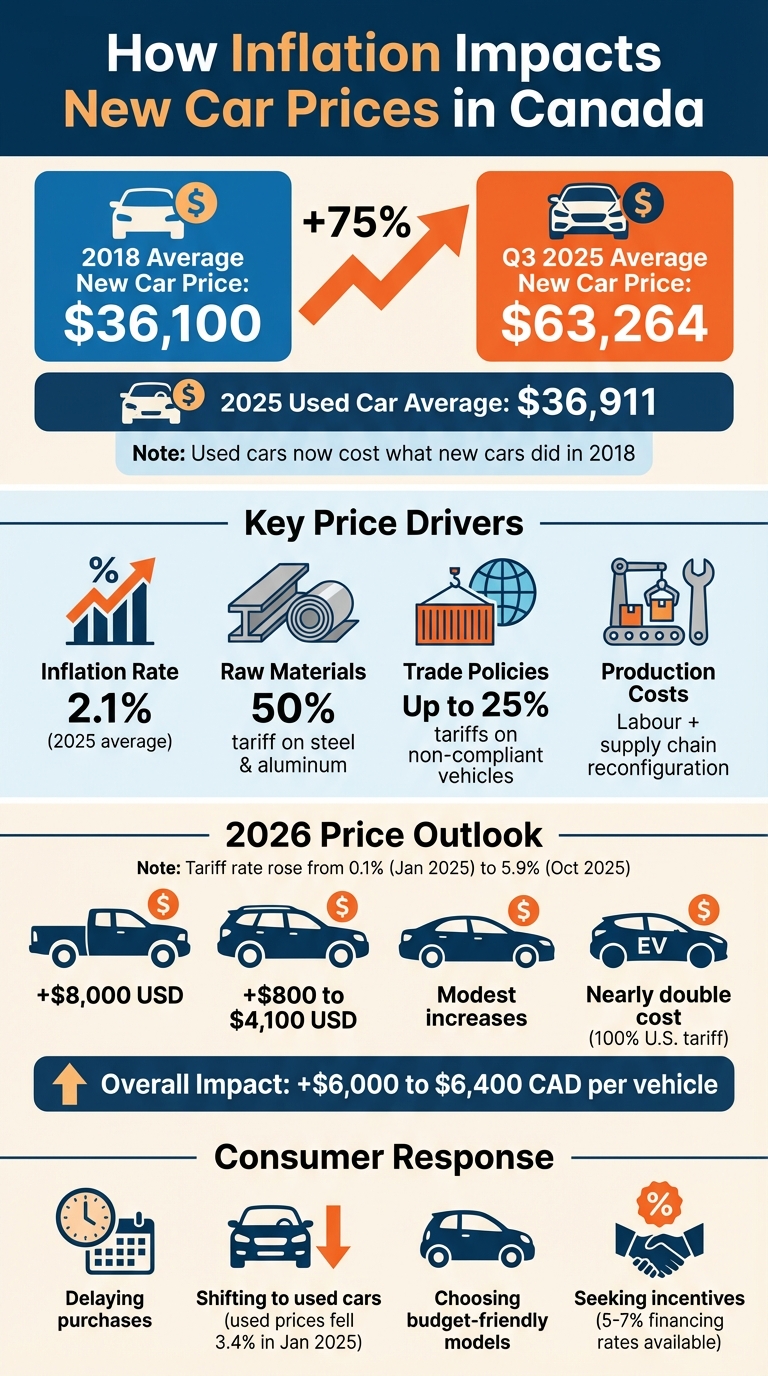
How Inflation Has Impacted New Car Prices in Canada (2018-2026)
Why are car prices skyrocketing and how high will they go?
How Inflation Increases New Car Prices
Inflation directly impacts the cost of producing vehicles, and automakers pass these increased expenses on to consumers. When the prices of materials like steel and aluminium rise, manufacturers have to adjust vehicle prices accordingly. Add tariffs and changes in trade policies to the equation, and the result is a staggering 30% increase in new car prices compared to pre-pandemic levels. These cost pressures are particularly evident in raw materials and labour.
Higher Production Costs for Automakers
The rising cost of raw materials, especially steel and aluminium, has been a significant factor. A 50% tariff on these materials, introduced in 2025, has further inflated production costs. Even small increases in material prices translate into millions of dollars in additional expenses for automakers producing vehicles at scale.
Labour costs have also surged, compounded by the CUSMA agreement, which mandates more local sourcing. This has forced automakers to reconfigure supply chains, a process that comes with hefty price tags. The Bank of Canada highlights this issue, noting that "The reconfiguration of global trade and domestic production is expected to put upward pressure on costs for businesses".
Modern cars add another layer of complexity. Larger vehicle sizes, advanced driver-assistance systems, and high-tech infotainment features all contribute to higher production costs compared to older models.
Tariffs and Trade Policies
Tariff policies further amplify production expenses. Automotive parts often cross international borders multiple times during assembly, with tariffs applied at each crossing. This compounding effect significantly inflates the final cost of vehicles. Candice Laing, President and CEO of the Canadian Chamber of Commerce, explains:
"The Canadian and American auto sectors are heavily intertwined - automotive parts can cross international borders up to eight times before a vehicle is finally assembled... Tariffs could add thousands of dollars to the cost of that vehicle".
By October 2025, the average tariff rate on Canadian exports rose from 0.1% at the beginning of the year to 5.9%. Vehicles that fail to meet CUSMA standards face a 25% tariff on their entire value, while even compliant vehicles incur a 25% tariff on non-U.S. content. This has contributed to passenger vehicle prices climbing at an annual rate of 4.1% as of June 2025.
In response to these tariffs, some automakers have shifted production locations to avoid steep costs. However, relocating production often requires expensive facility upgrades, and these additional expenses inevitably show up in the prices Canadian consumers pay at the dealership.
How Inflation Changes Consumer Buying Patterns
Rising production costs and tariffs are reshaping how Canadians approach buying decisions. With higher prices and interest rates, many are delaying vehicle upgrades, leaving dealerships with surplus inventory and households juggling tighter budgets. In particular, the housing market's economic pressures are leading families to prioritize mortgage payments and saving for down payments over spending on new vehicles.
These economic shifts are also influencing the kinds of vehicles people are buying. Many shoppers are gravitating toward brands with higher inventory levels, drawn by manufacturer incentives like reduced interest rates or cash rebates. While some buyers are sticking to budget-friendly options, luxury European brands such as Mercedes, BMW, and Audi, along with North American manufacturers like Ford, GM, and Stellantis, are offering notable discounts due to their larger inventories. Conversely, Asian brands known for hybrid models - like Toyota, Honda, and Hyundai - are facing limited supply, which means fewer discounts and higher prices. These trends are shaping both consumer preferences and pricing strategies across the market.
More Buyers Choosing Affordable Vehicle Models
With tighter budgets, Canadians are increasingly opting for economical vehicles. In January 2025, new passenger vehicle prices rose by 2.3%, pushing buyers to search for better value while still meeting their needs. In response, North American automakers have introduced cash incentives of up to 15% off the retail price. Shari Prymak, Senior Consultant at Car Help Canada, highlights the impact of supply levels on incentives:
"If the vehicles have a very good supply, they'll incentivize the interest rates and bring down the rates... But if the vehicle doesn't have any supply, if it has a long waiting period... the rates won't be incentivized".
For those focused on models with ample inventory, manufacturer financing rates between 5% and 7% are available. While affordable new vehicles are appealing to cost-conscious consumers, many are also exploring the used car market as a more economical alternative.
Growing Demand for Used Cars
The growing price gap between new and used vehicles is making pre-owned options increasingly attractive. In January 2025, while new car prices rose by 2.3%, used vehicle prices fell by 3.4%, with a peak decline of 7.6% recorded in September 2024. Daniel Ross, Senior Manager of Industry Insights at Canadian Black Book, notes:
"The new car market is normalizing faster than the used car market. You have the inventory, you have the incentives depending on where you're shopping and if you were a new car shopper from the beginning, it's the best situation you've had in a long time".
Additionally, many Canadians are choosing to delay purchasing altogether, focusing instead on repairs and maintenance to extend the life of their current vehicles. This trend underscores how inflation is reshaping consumer priorities and keeping the used car market in demand.
sbb-itb-20f5d75
How to Save Money on New Cars During Inflation
With inflation driving up production costs, car buyers face rising sticker prices. In fact, the average price of a new vehicle in Canada reached $63,264 in the third quarter of 2025. Thankfully, there are practical strategies and tools to help Canadians avoid overpaying and secure better deals despite these challenges.
Use Transparent Pricing Tools
One of the best ways to approach car buying during inflation is by using transparent pricing tools. These platforms provide access to dealer invoice pricing and real-time data, revealing the true cost of a vehicle before you even step into a showroom. Armed with this information, you can avoid hidden fees and last-minute price hikes.
Transparent pricing tools also allow you to focus on Canadian-built vehicles, which often come with fewer cost fluctuations. For example, models like the Honda CR-V and Civic (built in Alliston, Ontario), Toyota RAV4 (Woodstock, Ontario), and Ford Edge (Oakville, Ontario) tend to avoid import fees that can drive up prices. As Go Auto explains:
"Tariffs can raise your car price overnight - even if nothing else changes".
By prioritizing domestically manufactured cars, you can sidestep sudden price increases linked to trade policies.
Additionally, services like Price Driven offer free discount reports. These reports provide insights into dealer-level pricing, MSRP comparisons, and available discounts across various trims. This level of transparency helps you identify genuine deals, especially in a market where inventory levels and incentives can vary widely by brand.
Another effective tactic is to secure pre-arranged pricing, which removes the stress of lengthy negotiations.
How Pre-Negotiated Pricing Services Work
If you’re looking to save money without the hassle of negotiating, pre-negotiated pricing services can be a game-changer. For example, Price Driven offers a $99 service that provides access to pre-arranged prices with partner dealerships, ensuring you avoid dealer markups that could add thousands to the MSRP.
| Feature | Free Discount Reports | Pre-Negotiated Pricing ($99) |
|---|---|---|
| Access to Invoice Pricing | ✓ | ✓ |
| MSRP Comparisons | ✓ | ✓ |
| Dealer-Level Discount Data | ✓ | ✓ |
| Guaranteed Pre-Negotiated Price | ✗ | ✓ |
| Partner Dealership Access | ✗ | ✓ |
| No Dealer Fee Guarantee | ✗ | ✓ |
This service is especially useful during inventory shortages when dealers might inflate prices. Instead of dealing with unexpected costs like mandatory non-refundable deposits, you get clear terms upfront. It also guides you toward automakers that are handling supply chain issues more effectively, helping you find brands with better availability and stable pricing.
What to Expect for New Car Prices in 2026
By 2026, new car prices are expected to climb, driven largely by tariff-related cost increases, even with inflation holding at 2.0%. The upcoming review of the Canada-United States-Mexico Agreement (CUSMA) adds another layer of uncertainty, as automakers grapple with rising tariffs. While inflation and trade policies have already influenced production costs, 2026 will bring more noticeable price shifts across different vehicle categories. These economic changes are setting the stage for varied pricing trends depending on the type of vehicle.
Expected Price Changes by Vehicle Type
The impact of tariffs and changing manufacturing strategies will vary by vehicle type. For instance:
- Pickups: Prices could surge by as much as US$8,000.
- SUVs: Expected increases range from US$800 to US$4,100.
- Sedans: More modest price hikes are anticipated.
Interestingly, some manufacturers are taking steps to counterbalance these trends. Nissan, for example, has reduced the MSRP for its Rogue by $640 to $1,930 and for the Pathfinder by $670 to $1,170 to maintain consumer demand.
Electric vehicles (EVs) face unique challenges, as a 100% U.S. tariff is nearly doubling their costs, significantly influencing EV pricing across North America. In Canada, the combined effects of tariffs are projected to add approximately $6,000 to $6,400 to the cost of a new vehicle.
Possible Tariff Increases and Their Impact
Tariffs on raw materials are another factor driving up costs. The steel and aluminium tariff, which was raised to 50% in June 2025, continues to impact production expenses. Additionally, a proposed 25% tariff on imports from South Korea could raise prices on popular international models.
In response, manufacturers are adjusting production locations to align with CUSMA requirements. Models like the Chevrolet Equinox, Honda CR-V, and Jeep Compass are now being produced in compliance with these rules. However, automakers may soon stop absorbing these rising costs. As Jeremy Robb, Interim Chief Economist at Cox Automotive, points out:
"Tariff-related price hikes have not materialized as much as expected, but tariffs could still drive up prices as automakers run out of ways to offset the increases".
Beyond sticker prices, ownership costs are also expected to rise. Auto insurance premiums could increase by up to 5% in provinces like Alberta, where higher vehicle values are driving up repair and total loss claim expenses. Tariffs are also inflating the cost of parts and maintenance, affecting critical components like engines, transmissions, and electronics. Altogether, owning a new car in 2026 will likely become more expensive, making careful planning and informed decisions essential for buyers.
Conclusion
Inflation has reshaped Canada's automotive market in ways that go beyond simple price increases. Over the past few years, new car prices have climbed significantly, influenced by a mix of rising raw material costs, trade policies, and the increasing complexity of modern vehicles. These factors are setting the stage for notable changes in 2026.
The year 2026 marks a pivotal moment for the market. The formal review of CUSMA could play a key role in determining whether prices begin to stabilize or continue their upward trend. At the same time, a potential slowdown in demand during the year's first half might provide a temporary reprieve. As Dave Power, Partner and National Automotive Sector Leader at KPMG in Canada, puts it:
"To the extent that it [the trade situation] gets less favourable for North America ... it will get pricier. It is very hard to predict based on where that goes, but 2026 will be a big year for this."
In this uncertain landscape, buyers are finding it harder to navigate traditional dealership negotiations, as tighter profit margins leave little room for flexibility. Transparent pricing strategies are becoming essential. Tools like Price Driven offer a practical solution by providing reliable invoice pricing and pre-negotiated deals. With free discount reports and a $99.00 pre-negotiated pricing service, these platforms help buyers avoid the guesswork and secure fair deals without the usual back-and-forth.
One thing is certain: vehicle affordability won’t revert to pre-pandemic levels anytime soon. Used car prices now mirror what new cars once cost, and extended financing terms have become the norm as buyers aim to manage monthly payments. In this challenging market, making informed decisions is more important than ever. Knowing the true cost of ownership, timing purchases wisely, and using transparent pricing tools can be the difference between overpaying and getting a fair deal in Canada’s shifting automotive market.
FAQs
How do tariffs affect the cost of new cars in Canada?
Tariffs have a direct impact on the cost of new cars in Canada, particularly when it comes to imported vehicles. Take the 25% tariff on U.S.-made cars introduced in April 2025, for instance. This policy is expected to drive up prices on affected models by a staggering range - anywhere from $3,000 to $12,000. These added costs are typically passed down to consumers, resulting in much higher sticker prices at dealerships.
But the effects don’t stop there. Tariffs often trigger a chain reaction in the market. For example, some buyers may start looking at vehicles that aren't subject to tariffs or consider used cars instead. This shift in demand can cause prices in those segments to climb as well. The overall result? Tariffs add to rising costs and fuel inflation within Canada’s automotive sector.
How can Canadians save money on new cars despite rising prices?
Amid rising new car prices driven by inflation and supply chain issues, Canadians still have options to save money when purchasing a vehicle. One smart approach is using platforms like Price Driven, which provide access to invoice pricing, pre-negotiated deals, and dealer-level discounts. These tools take the stress out of negotiations and make it easier to find a better deal.
The timing of your purchase can also have a big impact. Dealerships often offer discounts during promotional events, at the end of a sales quarter, or when they're pushing to hit sales targets. Another tip? Look at slightly older models or vehicles that aren't in high demand to dodge some of the steepest price hikes.
Keeping an eye on market trends and price changes can also help you make an informed decision. By combining these strategies, you can stretch your budget further and find a car that fits your needs without breaking the bank.
Why are both new and used car prices increasing in Canada?
The increase in both new and used car prices across Canada can be traced back to a mix of factors working together. Inflation, rising production costs, and supply chain issues - some stemming from the pandemic - have made manufacturing new vehicles more expensive. As a result, the limited availability of new cars, combined with higher price tags, has pushed more buyers towards the used car market.
This shift in demand creates a knock-on effect. When new vehicles become pricier or harder to find, consumers naturally gravitate toward used cars. This surge in demand for pre-owned vehicles drives their prices higher as well. The cycle of limited supply and heightened demand keeps car prices elevated across the board in Canada.