When buying a car in Canada, understanding MSRP (Manufacturer’s Suggested Retail Price) and market price is key to saving money. MSRP is the manufacturer’s recommended price, while the market price reflects what buyers actually pay after discounts, incentives, and negotiations. The difference between these two prices is your leverage for a better deal.
Here’s why both numbers matter:
- MSRP serves as a baseline for comparison and includes the base price and factory-installed options but excludes taxes, freight, and dealer fees.
- Market price varies based on supply, demand, and regional trends. Researching this ensures you know if a dealer’s offer is fair.
- In Canada, additional costs like taxes (5–15%), freight, and dealer fees can significantly impact your final price.
To negotiate effectively:
- Use tools to find accurate market prices and dealer invoice costs.
- Compare quotes from multiple dealers, focusing on the out-the-door price.
- Be cautious of hidden fees and inflated add-ons.
- Timing matters - shop during end-of-year sales or when inventory is high for better discounts.
For high-demand models, you may pay close to or above MSRP. In such cases, consider alternatives like factory orders or expanding your search area. Tools like Price Driven can provide dealer cost insights and pre-negotiated pricing, helping buyers save an average of $700.
Key takeaway: Knowing both MSRP and market price transforms car buying from guesswork to a data-driven process, giving you the confidence to negotiate smarter and save money.
How MSRP Works for New Cars in Canada
What MSRP Covers and What It Doesn't
The MSRP (Manufacturer's Suggested Retail Price) represents the automaker's base price, including standard features and factory-installed options like upgraded engines, tech packages, or premium sound systems. But here's the catch: it doesn't cover everything, and that's where Canadian buyers often get surprised.
For example, if a 2025 Honda CR-V is listed with an MSRP of $28,000, that figure is just the starting point. Additional fees, such as freight and PDI (Pre-Delivery Inspection), typically add another $1,800 to $2,500. These charges cover shipping the car from the factory to the dealership and getting it ready for delivery.
Then there are provincial taxes. Depending on where you live, sales tax ranges from 5% in Alberta to 15% in some Atlantic provinces. In Ontario, for instance, a 13% HST on a $28,000 vehicle adds $3,640. On top of this, you may encounter dealer fees (usually $400 to $900), tire levies, and other regulatory charges that vary by province.
And don’t forget about dealer-installed extras. Things like rust proofing, paint protection, nitrogen-filled tires, or winter tire packages aren’t included in the MSRP and can add hundreds - or even thousands - of dollars to your final bill. The good news? MSRP is negotiable, and some of these extra fees might be as well. Knowing these details puts you in a stronger position when it’s time to negotiate.
Understanding these elements is key to knowing when you might pay below, at, or above the MSRP.
When You'll Pay Below, At, or Above MSRP
The actual price you pay for a car depends on market conditions like supply, demand, and inventory levels. In some cases, you can score a deal below MSRP. For instance, if there’s plenty of stock, buyers might save 5–10% off MSRP - like getting $1,500 off a $30,000 vehicle. This often happens with slower-selling models, cars nearing the end of their model year, or during sales events when dealers are eager to clear inventory. Being flexible with options like trim or colour can also help you negotiate a better deal.
In more balanced markets, you’re likely to pay close to MSRP. This is common with moderately popular models where supply meets demand and incentives are minimal. If several dealers quote similar prices or offer extras like low-interest financing, free maintenance, or winter tires, paying at MSRP can still be a fair deal.
However, there are times when you might pay above MSRP. This usually happens with high-demand, low-supply vehicles - like new electric models, popular SUVs, or limited-edition performance cars. During industry shortages, some dealers may add market adjustment fees, pushing prices thousands above the sticker. While it’s legal for Canadian dealers to charge more than MSRP, it’s wise to scrutinize large markups or expensive, bundled add-ons. A small premium might make sense if wait times are long and other dealers offer similar prices. But if the markup feels excessive, it’s worth shopping around or considering placing an order and waiting.
Why MSRP Matters for Negotiations
MSRP is more than just a price tag - it’s your starting point for negotiations. Since it’s set by the manufacturer and displayed on every window sticker or online build tool, it provides a clear, consistent baseline. This makes it easier to compare deals across dealerships and set realistic discount targets.
For example, aiming for 5% below MSRP on a mainstream model when conditions are favourable is a practical strategy. Framing your offer as “$2,000 below MSRP, including freight but before taxes” keeps the conversation clear and focused. It also helps you evaluate promotions - like a dealer’s “$1,500 off” offer - to see if it’s genuinely competitive or just a small reduction.
MSRP also simplifies comparing trims and options. Let’s say a higher trim with a sunroof and advanced safety features adds $3,500 to the MSRP. You can easily decide if those upgrades are worth the extra cost. Similarly, comparing MSRPs of competing models - like two compact SUVs priced at $32,000 and $35,000 - gives you a solid starting point before factoring in incentives or local market conditions.
Tools like Price Driven take this a step further by showing the dealer’s invoice price - the amount they actually pay the manufacturer. This transparency reveals the profit margin between invoice and MSRP, helping you gauge how much room there is for negotiation. With this knowledge, MSRP becomes more than just a number - it’s a tool that empowers you to negotiate smarter deals.
Understanding Market Price in Canada
What Affects Market Price
Market price represents the actual transaction cost of a vehicle after factoring in discounts, incentives, and negotiations. Unlike the Manufacturer's Suggested Retail Price (MSRP), which remains constant until a manufacturer decides to adjust it, market price fluctuates frequently. These changes depend on factors both locally and nationally, making it a dynamic figure to track.
One major factor is local inventory levels. When dealerships have an oversupply of vehicles, they face mounting carrying costs and increased pressure to sell, often resulting in prices that dip below MSRP. On the flip side, when stock is limited, dealers are less likely to offer discounts, keeping prices closer to or even above MSRP.
Seasonal demand also plays a significant role in Canada. SUVs and all-wheel-drive vehicles tend to fetch higher prices before and during the winter months when drivers prioritize safety and traction. Conversely, demand for convertibles and sports cars often wanes during colder months, making them more negotiable. Additionally, year-end and model-year transitions usually present opportunities for deeper discounts as dealerships clear out older inventory to make room for new models.
Another element is incentives. For example, a vehicle with $3,000 in combined incentives will have a market price that’s $3,000 lower than a similar model without those offers, even if both start with the same pre-incentive price.
Economic conditions add yet another layer. High interest rates tend to shift buyers’ focus toward monthly payments, prompting dealers to offer sharper discounts to maintain sales. Additionally, the exchange rate between the Canadian and U.S. dollar can influence pricing strategies. A weaker Canadian dollar may lead manufacturers to adjust MSRPs and incentives differently, further affecting the gap between MSRP and actual market prices.
Understanding these dynamics is crucial when you’re researching reliable market price data.
How to Find Market Price Data
Finding accurate market price data may take a bit of effort, but it’s a straightforward process. Start by using Canadian-focused pricing tools. These tools show MSRP, current incentives, and an average transaction range for your chosen vehicle model and trim, tailored to your postal code. They compile real transaction data to help you see if a price is below, at, or above the typical market range.
It’s also helpful to review dealer websites and advertisements from several local dealerships. Pay close attention to details like mandatory add-ons or hidden fees. Comparing offers from multiple dealers can give you a sense of the going rate and help you identify outliers.
If you’re trading in a vehicle, tools like Canadian Black Book can be invaluable. These services use market trends, historical data, and regional variations to provide accurate trade-in values. Knowing what your trade-in is worth can indirectly influence how much leverage you have when negotiating for a new vehicle.
Observing offline signals can also offer clues about pricing flexibility. For instance, if a dealership has large rows of the same model or vehicles that have been sitting on the lot for months, they’re likely more open to negotiating below the prevailing market price. Similarly, signs of dealer urgency - such as rapid follow-ups or bonus offers like free winter tires - indicate a willingness to negotiate.
Finally, collect written quotes from multiple dealers. If several dealers match or beat a specific quote, it’s likely close to the current market price. If none match it, you might be asking below market value, or you’ve found a dealer willing to offer an unusually low price.
These strategies lay the groundwork for using Price Driven to get even more precise pricing insights.
How Price Driven Helps
Price Driven provides a transparent look into dealer pricing with detailed reports. These reports include the dealer’s actual cost for a vehicle, as well as hidden incentives and factory discounts that aren’t typically advertised. Armed with this information, you’ll know the profit margin and have a clearer idea of how much room there is for negotiation.
The platform offers free discount reports that include dealer-level pricing insights, MSRP comparisons, and trim-specific details. This allows you to set realistic price targets based on what dealers are paying - not just what they’re asking. In April 2025, 28 out of 32 users reported being satisfied with the final price they achieved after using Price Driven, saving an average of over $700.
For even greater certainty, Price Driven offers a $99.00 service for pre-negotiated guaranteed pricing. This connects buyers with a network of certified partner dealerships that agree to upfront pricing and transparent terms. With this option, you avoid the back-and-forth negotiations and receive a guaranteed price that reflects current market conditions - without hidden fees or last-minute surprises. In April 2025, 30 out of 32 users noted an improved dealership experience through this service.
If you’re negotiating with non-partner dealers, you can still leverage the pricing range and incentives from your Price Driven report to support your offer. Showing that your number aligns with documented Canadian market data - not just guesswork - can strengthen your position. By combining invoice pricing, market value comparisons, and access to pre-negotiated deals, you’ll have the tools to confidently determine whether a deal is fair, overpriced, or a great bargain. With these insights, you’ll be well-equipped to negotiate deals that truly reflect the market.
Using MSRP and Market Price to Negotiate Better Deals
Setting Your Price Targets
Before stepping into a dealership, it's essential to set clear price targets. Start by identifying the exact MSRP (Manufacturer’s Suggested Retail Price) for the specific trim, drivetrain, and options you want. You can find this information on the manufacturer’s Canadian website using their build-and-price tool or by checking the window sticker at the dealership.
Next, research local transaction prices. Tools tailored for Canadian buyers can help you uncover the average transaction price and the dealer's invoice cost for the model you're considering. Typically, in a balanced market, buyers aim for a price that’s a few percentage points below MSRP - often in the range of 3% to 7%, depending on demand.
For example, if the MSRP is CA$40,000 and your research indicates most transactions range between CA$38,500 and CA$39,500, you might set your target price at CA$38,500, with a maximum acceptable price of CA$39,500. The target price is your ideal figure, while the maximum price is the highest you’re willing to pay before walking away.
Market conditions also play a big role. In a buyer’s market, where inventory is plentiful and sales are slower, discounts of 5% to 10% below MSRP may be achievable, especially if manufacturer or dealer incentives are available. On the other hand, in a tight market - like when demand is high or supply is limited due to supply-chain issues or popular new models - your expectations may need to adjust. In such cases, aiming for a small discount or even paying close to MSRP might be more realistic, with discounts closer to 1% to 3%.
Keep these numbers handy during negotiations:
- MSRP, including destination and freight charges.
- Dealer invoice cost or cost range.
- Current incentives, such as rebates or loyalty bonuses.
- Regional market data showing what similar buyers in your area are paying.
With these figures, you’ll be well-prepared to assess dealer offers objectively.
Comparing Dealer Offers to Your Targets
Once you’ve established your price targets, compare dealer quotes carefully. Request a detailed out-the-door quote that breaks down all costs, and match those against your targets. The quote should include the base vehicle price, options and packages, freight and pre-delivery inspection (PDI) charges, mandatory government fees (like sales tax and licensing), dealer fees (such as documentation charges), and any add-ons (like extended warranties or protection packages).
Pay close attention to fees that vary between dealerships, as well as any "mandatory" add-ons you didn’t request. Identifying these extras can help you negotiate a better deal.
For instance, consider an SUV with an MSRP of CA$45,000. Market data shows most buyers are paying between CA$43,000 and CA$44,000. One dealer might quote a vehicle price of CA$42,800 but tack on CA$2,000 in extra fees, bringing the total to CA$44,800 before tax. Another dealer might quote a vehicle price of CA$43,400 but include only standard freight, PDI, and reasonable administrative fees, for a total of CA$43,900 before tax. Although the first dealer’s price appears lower, removing optional add-ons could reveal a better deal. You can even use the lower vehicle price from one dealer as leverage when negotiating with another.
When comparing offers, ask yourself:
- Does the selling price (excluding taxes and fees) align with or beat your target?
- Is the price above or below MSRP, and by how much?
- How does the quote compare to the invoice price and the fair-market data you’ve gathered?
- Are dealer fees reasonable and consistent with what other local dealerships charge?
If you notice inflated or inconsistent fees, ask the dealer to adjust them or offset them by lowering the vehicle price. This method ensures you stay focused on the true cost of the vehicle.
Negotiating with Data
With your research and numbers in hand, approach negotiations confidently. Let data - not emotions - guide your discussions. Use the MSRP as your starting point and back your offer with market data. For example:
"The MSRP for this trim is CA$45,000, but local transaction data shows buyers paying around CA$43,000–CA$44,000. If we can settle at CA$43,200 plus tax and mandatory fees, I’m ready to move forward today."
Referencing market data indirectly strengthens your position. Stay composed, reiterate your target, and be ready to walk away if the dealer cannot meet a fair price. Dealers often respond with more competitive offers when they see you’re informed and prepared.
Negotiate one aspect at a time. Start with the vehicle price before discussing trade-ins, financing, or extras. This prevents the dealer from bundling numbers together, which can obscure the true cost. Avoid negotiating based on monthly payments; instead, focus on the all-in vehicle price and terms. If the dealer insists on a price above MSRP, ask for an explanation - whether it’s due to limited availability, long waitlists, or included extras. If the markup is tied to dealer add-ons (like paint protection or nitrogen-filled tires), request a quote without those items or negotiate a significant discount.
Timing can also give you an edge. Visiting near the end of the month, the end of a quarter, or during a model-year changeover can work in your favour, as dealers may be motivated to hit sales targets and offer better discounts. If a dealer pressures you with a "today-only" deal, stick to your walk-away rule. If the price exceeds your ceiling or includes too many unwanted fees, don’t hesitate to leave.
To strengthen your position further, consider tools like Price Driven. Their free discount reports provide insights into dealer pricing, MSRP comparisons, and trim-specific details. These reports can help you set realistic price targets based on actual dealer costs, not just the sticker price. Use this data as evidence during negotiations to show your target aligns with documented market trends.
If a dealer can’t meet your data-supported price range, Price Driven also offers a CA$99.00 pre-negotiated pricing service. This service guarantees pricing with certified partner dealerships, provides clear terms upfront, and eliminates hidden fees. Having this option as a backup can boost your confidence and ensure you don’t settle for a deal that doesn’t reflect fair market conditions.
sbb-itb-20f5d75
DON'T PAY MSRP (New Car Prices) Kevin Hunter The Homework Guy
When MSRP and Market Price Are Far Apart
Sometimes, the difference between the Manufacturer’s Suggested Retail Price (MSRP) and what buyers actually pay can be surprisingly large. Knowing why this happens and how to respond can help you make smarter decisions about when to buy, where to look, and how much to spend.
High-Demand Models with Limited Supply
When a car is in high demand but short supply, market prices often climb to - or even above - MSRP. Discounts disappear, and you might encounter extra charges like a market adjustment fee of around CA$3,000, plus mandatory accessory packages that drive the price even higher.
In these cases, paying MSRP without additional markups can feel like a win. For example, during the pandemic, microchip shortages and production delays made it common for many models to sell at or above MSRP.
If you're faced with a hefty premium on a high-demand vehicle, consider these strategies:
- Weigh the total cost of ownership: Compare the cost of buying now versus waiting six to twelve months. Factor in potential changes in interest rates, savings from a more fuel-efficient car, and the depreciation of your current vehicle.
- Expand your search area: Dealers in other cities or provinces may offer better pricing. Some might sell at MSRP without markups, while others add significant fees. Getting quotes from multiple regions - even if it means a road trip - can sometimes save you thousands.
- Order directly from the factory: Many manufacturers let you place custom orders at MSRP, bypassing dealer markups. While this might mean waiting weeks or months for delivery, market conditions could improve during that time, and you might secure a better deal.
- Explore alternatives: Consider a similar model from another brand, a less popular trim or colour, or even a lightly used one- to two-year-old version. These options often provide better value when market prices are inflated.
When market prices rise above MSRP, focus on reducing excess premiums rather than chasing discounts. Ask for a detailed price breakdown to separate the vehicle's base price from add-ons, and be ready to negotiate - or walk away - if the extras are too steep.
End-of-Year Clearance Sales
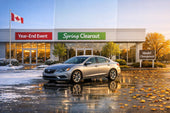
At the other extreme, market prices often fall well below MSRP during end-of-year clearance sales. Late autumn to early winter is when dealers discount outgoing inventory to make room for new models. Manufacturers often sweeten the deal with cash rebates, low-rate financing, or bonus accessories, which combine with dealer discounts to create significant savings.
For example, a midsize SUV with an MSRP of CA$48,000 might come with a CA$2,500 rebate, a CA$1,000 dealer discount, and 0.9% APR financing. This could bring the effective price down to CA$44,500 before taxes - a savings of about CA$3,500 or roughly 7% below MSRP. On slower-selling models or less popular colours, discounts can reach 10% or more.
To snag these deals, focus on older stock. Vehicles that have been sitting on the lot for months or are in less popular colours or trims are the ones dealers are most eager to move. Ask the sales manager which units have been there the longest and tailor your negotiations accordingly.
Timing also plays a role. Shopping during the last week of the month or quarter can give you extra leverage, as dealers push to hit sales targets and factory bonus thresholds. In some Canadian regions, winter weather slows showroom traffic, giving you even more bargaining power. When comparing a heavily discounted outgoing model to a lightly discounted new one, weigh the savings against factors like resale value, updated features, and warranty start dates. A previous-year model priced CA$5,000 lower might be the smarter choice, even if it lacks the latest tech, especially if the mechanical components are identical.
Request itemized quotes to confirm rebates, discounts, and fees. Being flexible on trim, colour, and options can unlock the biggest savings. Also, having pre-approved financing from a bank or credit union before visiting the dealer can help you determine whether the dealer's promotional rate or a larger cash rebate offers better value.
Tools like Price Driven can provide insight into a dealer’s invoice cost and hidden factory incentives. Their discount reports reveal trim-specific pricing and current offers, giving you a clear benchmark for negotiations during clearance periods.
Economic Changes and Price Shifts
Economic factors can also widen the gap between MSRP and market prices. Since MSRP is updated infrequently, actual transaction prices often respond more quickly to economic shifts, creating both risks and opportunities for buyers.
For example, rising interest rates increase borrowing costs, which can pressure dealers to drop prices below MSRP to maintain sales. Higher rates also reduce demand, prompting deeper discounts. On the flip side, when supply is tight, stricter lending approvals can limit who can pay above MSRP, sometimes reducing premiums. In Canada, rate announcements from the Bank of Canada often signal shifts in dealer pricing strategies, so keeping an eye on these trends can help you time your purchase.
For high-demand models with limited supply, market prices may stay at or above the new, higher MSRP, even as consumer budgets tighten. Meanwhile, less popular models might see extra discounts, rebates, or unadvertised incentives, creating a wider gap between MSRP and actual prices.
In volatile economic conditions, MSRP alone isn’t a reliable guide. Instead, monitor manufacturer offers like cash rebates, loyalty bonuses, and low-APR financing. Request itemized quotes from multiple dealers in your area - or even neighbouring provinces for high-volume models - to understand the current market landscape. This real-time data can help you spot a fair deal versus an overpriced one.
Platforms like Price Driven aggregate invoice data and pre-negotiated deals with Canadian dealers, letting you base your expectations on live market conditions rather than static MSRP figures. When economic pressures lead to higher incentives on slower-moving inventory, knowing the dealer’s invoice price and current offers helps you negotiate closer to their cost. Conversely, when demand keeps prices high, this transparency helps you identify reasonable premiums.
Whether market prices are far above or far below MSRP, relying on data-backed targets is far more effective than using MSRP as your only guide. Understanding the real market price and a dealer’s costs gives you the confidence to negotiate effectively - or walk away if the deal doesn’t offer genuine value. Use current invoice and discount reports to navigate these pricing extremes with clarity.
Conclusion
In Canada, there's no rule saying you have to accept the first price a dealer offers. By understanding both MSRP (Manufacturer’s Suggested Retail Price) and the market price, you can confidently negotiate and potentially save a significant amount.
MSRP is just a starting point. It’s not set in stone. In most cases, it’s negotiable, depending on supply, demand, and regional factors. To negotiate effectively, you need to know what others are actually paying - the market price. With this knowledge, you can establish a realistic range: the MSRP serves as the upper limit, while the dealer invoice price or fair-market transaction price becomes your target.
As explained earlier, understanding both MSRP and market price transforms the negotiation process from guesswork into a calculated strategy. The steps are simple: identify the MSRP for the model and options you want, research transaction prices and dealer invoices, and gather itemized, out-the-door quotes in CAD from multiple dealerships. Compare these quotes to your target range. If a dealer’s offer is significantly above the market price without a clear reason (like low supply or high demand), don’t hesitate to walk away. This approach puts you in control and increases your chances of saving money.
Your strategy should also adjust based on market conditions. For instance, during high-demand periods or when inventory is tight, you might have to pay close to or even above MSRP. Conversely, during end-of-year or model clearance sales, prices often dip below MSRP, giving you more room to negotiate. Economic shifts, like changes in interest rates or new incentives, can also impact the gap between MSRP and actual transaction prices, making it essential to use up-to-date data.
Here’s an example: a buyer in Ontario looking at an SUV with an MSRP of CA$45,000 might find, through research, that recent deals are closing at around CA$43,000–CA$44,000. This knowledge could save them CA$1,500–CA$2,000 before taxes and fees. Even small wins add up. For instance, negotiating a 3–5% discount on a CA$35,000 car saves CA$1,050–CA$1,750, which can noticeably lower monthly payments and overall costs.
For those who want to simplify the process, Price Driven is a helpful tool for Canadian buyers. It provides transparent invoice-level pricing and typical discounts across the country. You can access free discount reports showing MSRP, dealer invoice prices, and estimated savings for specific models. These reports help you set realistic, data-driven targets before stepping into a dealership. If you prefer to avoid negotiating altogether, Price Driven also offers pre-negotiated deals with partner dealerships. On average, customers saved over CA$700 without the hassle of back-and-forth bargaining. The platform even accounts for Canada-specific fees like freight/PDI and dealer add-ons, giving you a clearer picture of your total cost.
Real buyers have shared how this approach works for them:
"The transparent pricing gave me confidence, and the pre-negotiated deal saved me hundreds." – Lucas H, London, ON
"Knowing how much discount there is, helps with negotiating the price." – Michael S, Vancouver, BC
When you rely on data instead of guesswork, you negotiate with confidence and leave with a deal that feels fair. Always ask yourself: "How does this offer stack up against invoice pricing and current market trends in my area?" That question alone can make all the difference.
FAQs
How can I use MSRP and market price data to negotiate a better deal on a new car in Canada?
Getting a great deal on a new car starts with knowing the MSRP (Manufacturer's Suggested Retail Price) and comparing it to the market price. The MSRP is the price the manufacturer recommends, while the market price shows what people in your area are actually paying for the same vehicle.
By researching both, you can spot where savings might be possible. Check market price trends to see if discounts or incentives are common for the model you're eyeing. Armed with this knowledge, you can confidently negotiate with dealerships, aiming for a price closer to - or even below - the market value, especially if there are promotions running.
To make the process easier, tools like Price Driven can be a game-changer. They offer transparent invoice pricing, pre-negotiated deals, and exclusive dealer discounts, saving you time and helping you lock in a great price with minimal hassle.
How can I find accurate market price data for vehicles in my area?
To get a clear picture of vehicle pricing in your area, start by looking up the Manufacturer’s Suggested Retail Price (MSRP) for the car model you’re considering. Once you have that, compare it with local market prices by browsing dealership listings, online marketplaces, and recent sales data. This comparison will help you understand what people are actually paying for the vehicle.
If you want to simplify the process, tools like Price Driven can be a game-changer. They offer access to transparent invoice pricing, pre-negotiated deals, and dealer-level discounts specifically for new cars in Canada. This not only saves time but also gives you the confidence to negotiate a better deal.
When is the best time to buy a car to get a price below the MSRP, and what should you consider?
Timing can make a big difference when it comes to snagging a better deal on a new car. The end of the month, quarter, or year is often your best bet since dealerships are usually trying to hit sales targets and may be more willing to offer discounts. Another good time to shop is during slower months, like January or February, when demand tends to drop.
It’s also smart to think about factors like how popular the vehicle is, how much stock is available, and market trends. If a car is in high demand or inventory is tight, negotiating for a price below the MSRP (Manufacturer's Suggested Retail Price) might be tougher. To get a clearer picture, research both the MSRP and the market price - this will give you a sense of what others are paying. Tools like Price Driven can be especially handy, offering transparent pricing details and access to pre-negotiated deals, helping you lock in a competitive price right here in Canada.