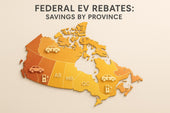
Electric vehicle (EV) rebates can help lower the upfront cost of zero-emission vehicles (ZEVs), making them more accessible. As of 2026, federal EV incentives in Canada have ended, leaving provincial and territorial programs as the only rebate options. Here's what you need to know:
- Federal iZEV Program: Concluded in January 2025 after funding over 230,000 claims with $2.3 billion. Rebates were up to $5,000 but are no longer available.
-
Provincial Programs: Rebates differ by province. For example:
- Manitoba: Up to $4,000 for new EVs; ends March 31, 2026.
- Prince Edward Island: $4,000 for new/used EVs, plus $750 for home chargers.
- Quebec: $2,000 for new EVs; program phases out by 2027.
- British Columbia: Rebates paused since May 2025.
- Application Processes: Vary by province. Some rebates are applied at the dealership, while others require reimbursement applications.
With federal rebates gone, understanding provincial programs is key to maximizing savings. Eligibility, rebate amounts, and processes vary widely, so check your province's specific rules before purchasing an EV.
Federal EV Rebates
Federal Rebate Amounts and Eligibility
The federal Incentives for Zero-Emission Vehicles (iZEV) Program officially came to an end on January 12, 2025. Originally scheduled to run until March 31, 2025, the program was halted early after funds were depleted. Between its launch in May 2019 and its closure, the program funded over 230,000 incentives, with a total investment surpassing $2.3 billion.
At its height, the iZEV program provided rebates of up to $5,000 for battery electric vehicles (BEVs), fuel cell electric vehicles (FCEVs), and long-range plug-in hybrid electric vehicles (PHEVs) with an electric range of 50 km or more. Shorter-range PHEVs qualified for rebates of up to $2,500. However, eligibility hinged on strict manufacturer’s suggested retail price (MSRP) limits, outlined below. Notably, freight, delivery, and accessory fees were excluded from these caps.
| Vehicle Type | Base Model MSRP Cap | Higher Trim MSRP Cap | Max Rebate |
|---|---|---|---|
| Passenger Cars | < $55,000 | $65,000 | $5,000 |
| SUVs, Pickups, Vans | < $60,000 | $70,000 | $5,000 |
For leased vehicles, the rebate amount was adjusted based on the lease term. A full 48-month lease qualified for the entire rebate, while a 24-month lease received only 50% of the eligible amount. Individual buyers were limited to one rebate per calendar year, while businesses and government fleets could claim up to 10 incentives annually.
How to Apply for Federal Rebates
With the program now closed, applications are no longer being accepted. When the iZEV program was active, the process was streamlined for buyers, as it was handled entirely at the point of sale by participating dealerships. Buyers filled out a Consumer Consent Form to confirm their eligibility and an Incentive Received Form to acknowledge the rebate. Dealerships then applied the rebate directly to the purchase price, ensuring all taxes and fees were calculated before deducting the incentive. Buyers could also combine federal rebates with provincial programs to maximize their savings.
The program’s closure has left a noticeable gap in the market. After the incentives ended, new EV sales in Canada dropped by 44.9% in March 2025, compared to the same period in the previous year. Brian Kingston, CEO of the Canadian Vehicle Manufacturers' Association, commented:
"EV sales have collapsed in Canada. The end of purchase incentives and the growing EV charging gap are the culprits".
Although the federal government is considering ways to reintroduce purchase incentives, no new program has been announced. For now, buyers must rely exclusively on provincial rebate programs to reduce the cost of EVs.
State of EV sales now that rebates are gone! //2025 EV Update
Provincial EV Rebates
Provincial rebates have become the primary source of government incentives for electric vehicle (EV) buyers in Canada. Knowing the specifics of these programs can help maximize your savings. Here's a closer look at the key provincial initiatives, from British Columbia to Newfoundland and Labrador.
British Columbia
British Columbia's CleanBC Go Electric program was paused on May 15, 2025. Previously, it offered income-based rebates of up to $4,000 for new battery-electric vehicles (BEVs) and $2,000 for plug-in hybrids (PHEVs). To qualify, vehicles needed a base MSRP below $55,000, with a cap of $70,000 for higher trims. However, the program excluded individuals earning more than $100,000 annually.
B.C. has been a leader in EV adoption, with electric vehicles making up 22.4% of new vehicle sales historically. While the CleanBC rebates are currently paused, residents can still receive up to $300 through the SCRAP-IT program by scrapping a gas-powered vehicle in favour of an EV. Whether or not the rebate program will return remains uncertain.
Quebec
Quebec's Roulez vert program continues to offer some of the most generous rebates in the country. As of 2026, buyers can receive up to $2,000 for new BEVs and fuel cell electric vehicles, and $1,000 for PHEVs. Eligible vehicles must have an MSRP under $65,000, and rebate amounts are set to gradually decrease each year until the program ends in 2027.
The province is shifting its focus toward other areas, such as infrastructure. Starting in 2027, BEV owners will face an annual registration fee of $125, while PHEV drivers will pay $62.50 to offset lost fuel tax revenue. Additionally, Quebec's 2025 budget introduced a new luxury vehicle tax: starting in 2027, vehicles valued over $62,000 will incur an annual fee of 1% of their market value, removing the previous $75,000 exemption for zero-emission vehicles.
Other Provinces
- Manitoba: Offers $4,000 for new EVs and $2,500 for used EVs, applicable to vehicles priced under $70,000. The program runs until March 31, 2026, and applications are processed online through Manitoba Public Insurance (MPI) after vehicle registration.
- Prince Edward Island: Provides $4,000 for both new and used EVs, $2,000 for PHEVs, and an additional $750 rebate for purchasing and installing Level 2 home charging stations.
- Newfoundland and Labrador: Offers $2,500 for new or used BEVs and $1,500 for PHEVs, with the program running until March 15, 2026.
Some provinces, however, have discontinued their programs. New Brunswick ended its incentives on July 1, 2025, and Nova Scotia terminated its light-duty rebate program on April 4, 2025. Currently, Ontario, Alberta, and Saskatchewan do not provide any provincial purchase incentives.
EV Adoption Trends
ZEV (zero-emission vehicle) sales in Canada fell to just 8% of total vehicle sales during the first eight months of 2025, a decline from 14.5% in 2024. As Brian Livingston, Senior Fellow at the C.D. Howe Institute, observed:
"ZEV adoption remains highly dependent on government incentives, and hybrids continue to attract significant consumer demand despite being excluded from compliance under the mandate".
sbb-itb-20f5d75
Federal vs. Provincial Rebates: Key Differences
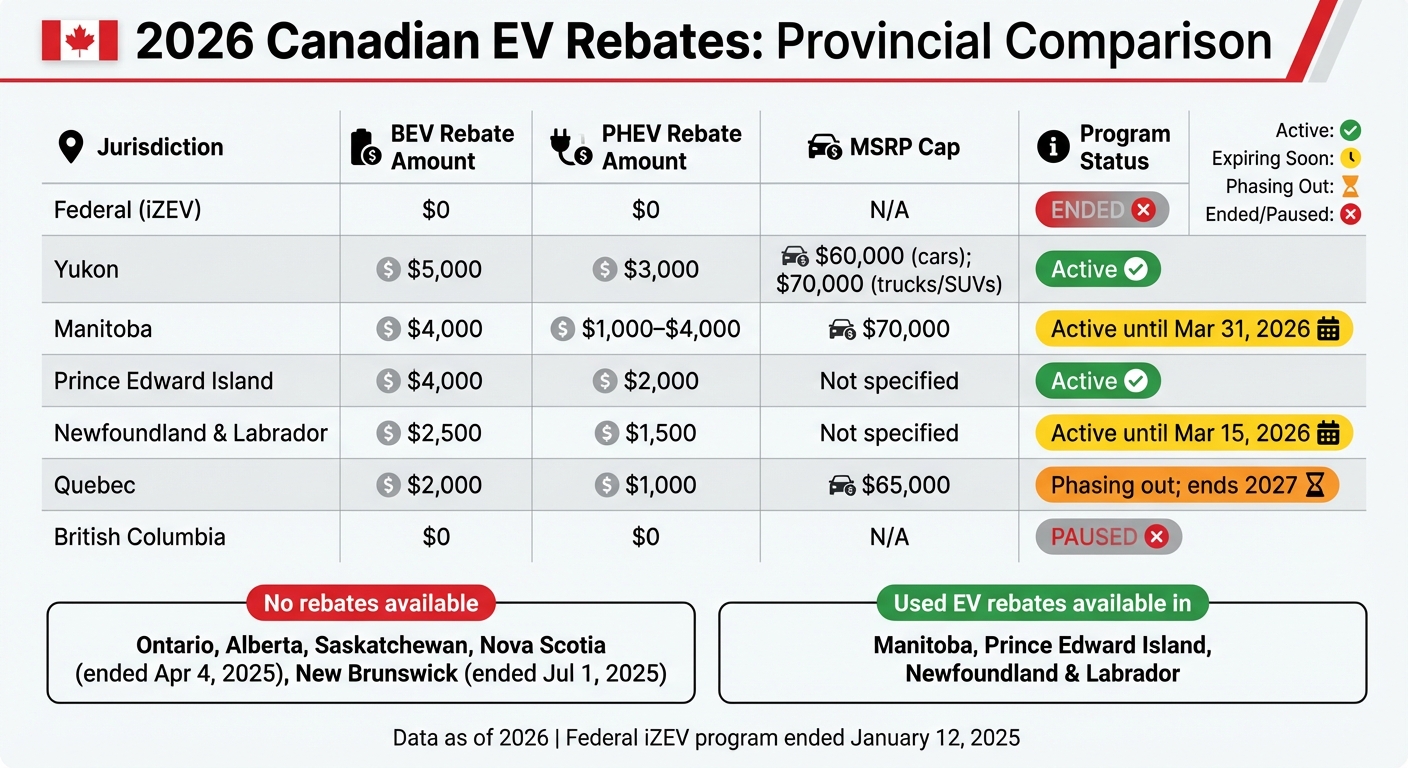
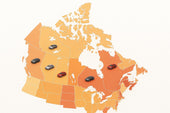
2026 Canadian EV Rebates by Province Comparison Chart
With the federal iZEV program now out of funds, provincial programs have taken centre stage as the main source of incentives for purchasing electric vehicles (EVs). This shift highlights the differences in rebate amounts, eligibility rules, and how rebates are claimed, creating a patchwork of options across Canada. Let’s break down the key distinctions in eligibility and application processes.
Rebate Comparison Table
| Jurisdiction | BEV Rebate | PHEV Rebate | MSRP Cap | Program Status |
|---|---|---|---|---|
| Federal (iZEV) | $0 | $0 | N/A | Ended |
| Yukon | $5,000 | $3,000 | $60,000 (cars); $70,000 (trucks/SUVs) | Active |
| Manitoba | $4,000 | $1,000–$4,000 | $70,000 | Active until Mar 31, 2026 |
| Prince Edward Island | $4,000 | $2,000 | Not specified | Active |
| Newfoundland & Labrador | $2,500 | $1,500 | Not specified | Active until Mar 15, 2026 |
| Quebec | $2,000 | $1,000 | $65,000 | Phasing out; ends 2027 |
| British Columbia | $0 | $0 | N/A | Paused |
Eligibility Differences
One of the biggest variations between programs is the MSRP cap, which determines which vehicles qualify for rebates. For instance, Quebec limits eligibility to vehicles priced below $65,000, while Manitoba allows vehicles up to $70,000. The federal iZEV program, when active, had a stricter base MSRP cap of $55,000, which often led to inconsistencies with provincial programs.
Some provinces now extend rebates to used EVs. Manitoba, Prince Edward Island, and Newfoundland and Labrador include used vehicles in their incentive programs, broadening accessibility. Quebec, on the other hand, has added income-based restrictions and plans to introduce annual registration fees in 2027 - $125 for fully electric vehicles (BEVs) and $62.50 for plug-in hybrids (PHEVs) - to offset the loss of fuel tax revenue.
Application Process Differences
How you claim a rebate also depends on where you live. The federal iZEV program used a point-of-sale system where the rebate was applied directly at the dealership. As Transport Canada described:
"The dealership or authorized seller is responsible for submitting the documentation required to be reimbursed for an incentive provided at the point-of-sale. Consumers cannot submit a request for reimbursement."
Some provinces, like Prince Edward Island and Yukon, have kept this approach, making it easier for buyers to benefit immediately. Others, like Manitoba and Newfoundland and Labrador, require buyers to pay the full purchase price upfront and apply for reimbursement later. In Manitoba, applications go through Manitoba Public Insurance after vehicle registration, while Newfoundland and Labrador processes rebates via NL Hydro. These reimbursement-based models can affect cash flow for buyers, as they need to cover the full cost initially before receiving their rebate cheque.
How to Maximize Your EV Rebate Savings
Stacking Federal and Provincial Rebates
Although the federal iZEV program has been paused since January 12, 2025, you can still save in 2026 by combining provincial vehicle rebates with home charger incentives. For instance, residents of British Columbia can receive up to $350 for a home charger, covering 50% of installation costs. In Yukon, buyers can pair a $5,000 vehicle rebate with up to $1,500 for charger installation. By aligning these programs, you can make the most of your savings.
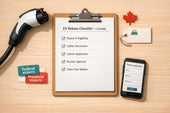
Before you make a purchase, check the details of your province's rebate program. Some offer point-of-sale rebates, while others require reimbursement later. Also, confirm that your vehicle's trim meets the MSRP cap to avoid surprises. Keep in mind that rebate programs can run out of funds unexpectedly, as seen with British Columbia's program, which paused on May 15, 2025.
Using Price Driven for Transparent Pricing
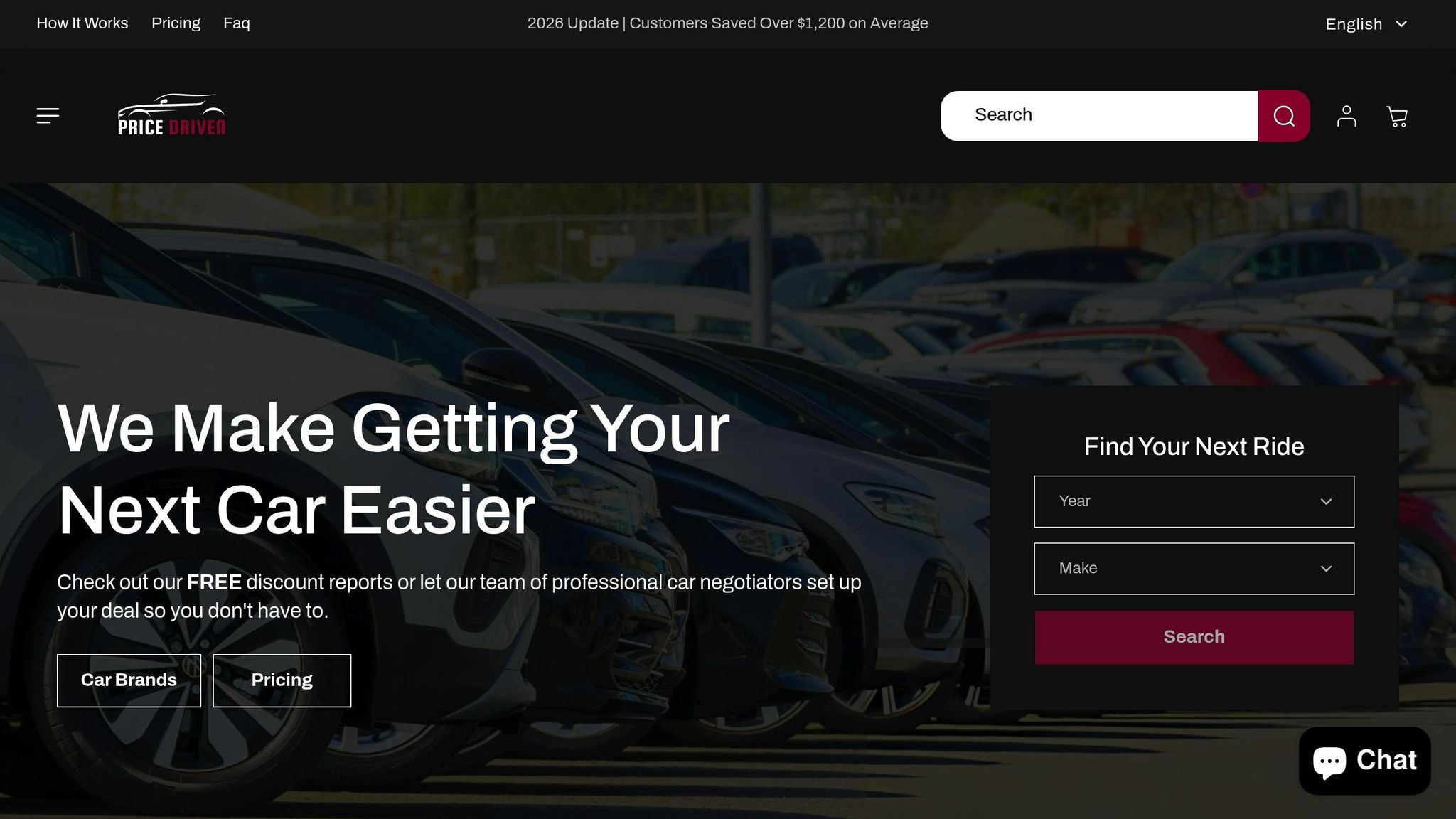
To maximize your savings beyond rebates, understanding the true dealer cost is key. Price Driven makes this easier by providing transparent pricing and pre-negotiated deals. While rebates reduce the sticker price, having access to the actual dealer cost ensures even greater savings.
Price Driven offers free reports that reveal dealer costs and confirm MSRP details for specific trims - especially helpful when MSRP caps affect rebate eligibility. For $99.00, their pre-negotiated pricing service secures guaranteed savings with partner dealers, eliminating the hassle of negotiating. With your purchase price locked in through Price Driven, you can focus on managing rebate applications, meeting residency requirements, and adhering to lease terms, all while enjoying a streamlined buying experience.
Conclusion
The EV rebate landscape in Canada has undergone major shifts in 2026. The federal iZEV program, which previously offered up to $5,000 for battery-electric vehicles, has officially wrapped up after handling a large number of claims. Now, provincial and territorial programs are the sole sources of purchase incentives, each operating with its own set of rules.
These provincial programs differ in how they structure their incentives, including MSRP caps and application processes. Some provide rebates directly at the point of sale, while others require buyers to go through a reimbursement process. Quebec, known for its generous rebates in the past, is gradually winding down its program, aiming to phase it out entirely by 2027. On the other hand, several provinces have broadened their scope to include rebates for used EVs - an option the federal program never covered.
FAQs
What are the main differences between federal and provincial EV rebates in Canada?
The key differences between federal and provincial EV rebates in Canada lie in their scope, eligibility criteria, and application processes. At the federal level, programs like the iZEV initiative offer up to $5,000 for qualifying zero-emission vehicles (ZEVs), such as battery-electric and plug-in hybrid models. These rebates are applied directly at the point of sale and are available across Canada. However, the federal program is expected to pause or end by late 2025 due to funding limitations.
Provincial rebates, in contrast, vary significantly depending on the province. For instance, British Columbia and Quebec have traditionally provided generous incentives, which can often be stacked with federal rebates for additional savings. Meanwhile, some provinces have discontinued their programs altogether. Unlike the federal process, provincial rebates often require buyers to complete a separate application after purchase, including submitting necessary documents. These programs are also tied to regional policies and available funding.
Since rebate programs are subject to frequent changes, it’s crucial to verify the current details and eligibility for both federal and provincial incentives before buying an EV to ensure you get the best possible savings.
How do provincial EV rebate application processes differ across Canada?
Provincial electric vehicle (EV) rebate applications in Canada differ across regions, with each province setting its own rules, required documents, and steps for applying. For example, in British Columbia, applicants need to use the BC Services Card app or a Basic BCeID account for pre-approval. This process includes verifying identity and disclosing income. On the other hand, Quebec has a more straightforward online system, while other provinces rely on their own portals or forms tailored to their rebate programs.
Typically, the application process includes confirming the vehicle’s eligibility, providing personal identification, and, in some cases, submitting proof of income. However, the exact steps and documentation vary depending on where you live. To avoid any issues, it’s crucial to carefully review your province’s specific rebate guidelines and follow the instructions closely. These regional differences are designed to ensure the programs meet the needs of local residents effectively.
Which provinces in Canada currently offer rebates for used electric vehicles?
In Canada, Prince Edward Island and New Brunswick are offering rebates for used electric vehicles. Both provinces provide a rebate of $5,000 for battery electric vehicles, matching the earlier federal incentive amount.
These initiatives are designed to make owning an EV more affordable, encouraging Canadians to adopt cleaner and more sustainable transportation options.