Dealer markups in Canada are extra charges added by dealerships on top of the vehicle's MSRP (Manufacturer's Suggested Retail Price). These markups vary across provinces due to factors like demand, vehicle type, and local regulations. Some provinces, like British Columbia, enforce stricter rules requiring upfront fee disclosure, while others, such as Ontario, allow more flexibility for dealerships to add extras.
Key Takeaways:
- What are markups? Extra fees or price adjustments added by dealers, often negotiable.
- Who pays them? Over 36% of buyers in Canada have paid above MSRP in recent years, with 85% of these markups ranging from $1,000 to $10,000.
- Why do they matter? They increase the overall cost of ownership, including financing and insurance.
- How to avoid them? Learn your province’s consumer protection laws, request itemized pricing, and negotiate unnecessary fees.
Provincial Highlights:
- Ontario: High SUV sales and bundled add-ons drive up prices.
- Québec: Rising SUV prices, fewer EV rebates, and growing used car sales.
- British Columbia: Transparent pricing rules but higher average prices due to premium EV and truck demand.
- Alberta: Dominated by pickup sales with steep markups on popular models.
- Atlantic Canada: Lowest prices nationwide, with budget-friendly SUVs under $20,000.
- Prairies: Strong truck demand but limited options for lower-priced vehicles.
Tips to Save:
- Research your province’s regulations (e.g., Ontario’s all-in pricing rules).
- Spot and challenge vague fees like admin or documentation charges.
- Use tools like Price Driven for transparent invoice pricing and pre-negotiated deals.
Dealer markups are common but negotiable. By understanding regional trends and leveraging local rules, you can avoid unnecessary costs and secure a fair deal.
How Dealer Markups Work in Canada
Pricing Terms Explained
Understanding vehicle pricing starts with a few key terms. The MSRP (Manufacturer's Suggested Retail Price) is essentially a guideline price - more of a starting point than a final figure. Then there’s the invoice price, which is what the dealer pays for the vehicle, often reduced by factory incentives that lower their actual cost. Finally, the sale price is what you pay after factoring in the dealer’s profit margins, any markups, and negotiated discounts. Dealers make their money by marking up the invoice price and often adding mandatory extras or bundled add-ons. Knowing how these pricing elements work is crucial to grasping the bigger picture of dealer markups across Canada.
National Data on Markups and Fees
Recent research offers some eye-opening insights into dealer markups in Canada. According to a 2023 survey by Car Help Canada, 36.6% of Canadian buyers paid more than the MSRP for their vehicles over the past two years. Of these, 85% faced markups ranging from $1,000 to over $10,000 CAD. On top of that, 41.3% of buyers were required to purchase dealer-added products, like extended warranties or protection packages, as part of the deal. This practice, often called tied selling, bundles these extras into the vehicle price.
The broader picture shows the scale of the industry: by 2025, Canada’s new car dealership market is projected to hit $175.5 billion, with activity concentrated in high-population provinces like Ontario. These areas tend to experience higher demand, which often leads to steeper markups. Together, these numbers highlight the financial pressures facing buyers and the role of market dynamics in shaping pricing practices.
How Economic Factors Affect Markups
Economic trends also play a big role in driving dealer markups. Rising vehicle prices and higher interest rates have made these markups even more impactful on overall affordability. Even a relatively small markup can significantly increase the total cost of financing, as higher interest rates amplify the charges on the inflated amount. With MSRPs steadily climbing across the industry, even a minor percentage markup can result in a much larger dollar figure.
Unfortunately, the lack of transparent pricing means buyers often need to rely on strong negotiation skills to avoid overpaying. These economic pressures add another layer to understanding the regional and provincial pricing differences that will be explored next.
I explain standard Ontario new car fees you can expect over MSRP
Dealer Markups by Province
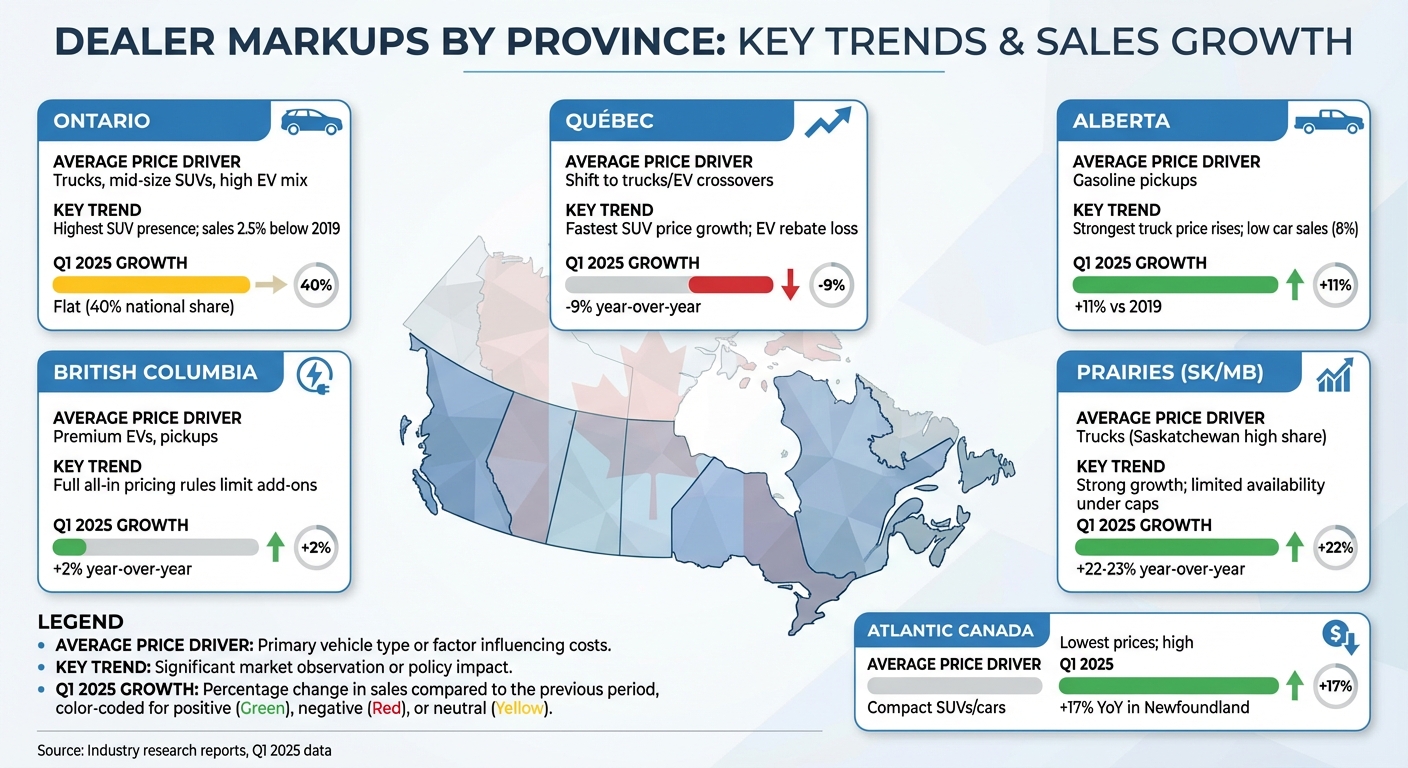
Dealer Markups by Province in Canada: Regional Pricing Trends and Sales Growth Comparison
Provincial Pricing Practices Overview
Dealer markups in Canada vary widely depending on the province, reflecting differences in vehicle preferences, economic factors, and local regulations. For instance, provinces like Alberta and British Columbia often see higher average vehicle prices due to strong demand for gasoline-powered pickups and premium electric vehicles. In contrast, central Canada showcases a mix of trends: Ontario is leading in SUV sales, while Québec is moving away from traditional cars towards trucks and electrified crossovers. Meanwhile, Atlantic Canada stands out with the lowest average prices nationwide.
Regulations also play a big role in shaping these differences. British Columbia’s "all-in pricing" rules require dealers to disclose all fees upfront, reducing the chance for hidden markups. On the other hand, provinces such as Ontario allow more flexibility for dealers to add extras like rustproofing, administration fees, and protection packages. This creates varying levels of transparency in the buying process across the country.
Here’s a closer look at how these trends break down by province.
Province-by-Province Breakdown
- Ontario: As the SUV leader in Canada, Ontario hit record SUV sales in August 2025. Higher-priced electric vehicles (EVs) and bundled add-ons contribute to the province's elevated average prices. In Q1 2025, Ontario made up 40% of national new vehicle sales, though volumes were still 2.5% below 2019 levels.
- Québec: SUV prices in Québec are growing faster than in any other province. A shift from traditional cars to trucks and electrified crossovers has pushed prices higher, even as premium EV prices have fallen. The end of provincial EV rebates led to a 9% drop in new vehicle sales, totalling 94,752 units. Despite this, Québec remains the national leader in car sales share and is seeing a surge in its used car market.
- British Columbia: Including the territories, British Columbia sold 50,018 new vehicles in Q1 2025 - a 2% year-over-year increase and a slight 0.4% rise compared to 2019. The province’s all-in pricing rules ensure full fee disclosure, preventing surprise charges. Premium EVs and pickups dominate the market, driving up average prices while maintaining a transparent buying process.
- Alberta: Known for its "truck effect", Alberta has only 8% of sales coming from passenger cars. The province’s heavy reliance on gasoline-powered pickups, particularly heavy-duty models, has led to the steepest month-over-month increases in truck prices. Alberta sold 55,218 new vehicles in Q1 2025, marking an 11% increase compared to 2019. Popular models like the F-150 and Sierra often come with steep markups due to high demand.
- Atlantic Canada: This region offers a stark contrast to the rest of the country. Newfoundland and Labrador, for example, reported the highest per capita new vehicle sales at 14.3 vehicles per 1,000 people in Q1 2025, a 17% year-over-year increase. Low-priced SUVs under $20,000 - such as the Escape, Rogue, and Tucson - are common, making this region particularly appealing to budget-conscious buyers.
- The Prairies (Manitoba and Saskatchewan): These provinces saw strong year-over-year growth of 22–23% in Q1 2025. Saskatchewan mirrors Alberta’s heavy focus on trucks, which has led to rising prices for half-ton pickups. Limited availability of vehicles under price caps is also creating challenges for buyers in the region.
Provincial Comparison Table
Here’s a summary of key trends and drivers by region:
| Province/Region | Average Price Driver | Key Markup/Trend Note | Q1 2025 New Sales Growth |
|---|---|---|---|
| Ontario | Trucks, mid-size SUVs, high EV mix | Highest SUV presence; sales 2.5% below 2019 | Flat (40% national share) |
| Québec | Shift to trucks/EV crossovers | Fastest SUV price growth; EV rebate loss | -9% year-over-year |
| Alberta | Gasoline pickups | Strongest truck price rises; low car sales (8%) | +11% vs 2019 |
| British Columbia | Premium EVs, pickups | Full all-in pricing rules limit add-ons | +2% year-over-year |
| Atlantic Canada | Compact SUVs/cars | Lowest prices; high per capita sales | +17% YoY in Newfoundland |
| Prairies (SK/MB) | Trucks (Saskatchewan high share) | Strong growth; limited availability under caps | +22–23% year-over-year |
Sources: Industry research reports.
sbb-itb-20f5d75
Provincial Regulations and Consumer Protection
Provincial Regulators and Their Rules
Beyond the variations in provincial pricing trends, local regulations play a key role in shaping how dealer markups are presented to buyers.
Each province has its own regulatory body overseeing how dealers advertise and sell vehicles. In Ontario, the Ontario Motor Vehicle Industry Council (OMVIC) enforces strict all-in price advertising rules. This means the advertised price must include all dealer fees and charges, except for HST and licensing. Over in Québec, the Autorité des marchés financiers (AMF) and the Office de la protection du consommateur (OPC) require dealers to include all mandatory fees in the advertised price and prohibit misleading practices like drip pricing.
In Alberta, the Alberta Motor Vehicle Industry Council (AMVIC) mandates that advertised prices include all mandatory fees, except GST. Dealers are also prohibited from passing ambiguous charges, like "AMVIC fees", onto consumers. Similarly, British Columbia's Vehicle Sales Authority (VSA) requires that documentation or dealer fees be clearly included in the upfront advertised price. Meanwhile, the Atlantic provinces rely on consumer protection acts to regulate dealers, promoting full-price disclosure. However, enforcement resources and the specificity of rules around auto markups tend to be less consistent compared to larger provinces. These frameworks set the stage for the enforcement challenges and pricing dynamics discussed next.
Enforcement Problems and Gaps
Although these rules exist, enforcement is largely complaint-driven in most provinces. For example, OMVIC handles over 4,000 consumer inquiries and complaints annually about vehicle transactions. In Alberta, AMVIC reports that vehicle sales and repairs are among the most common sources of complaints. Similarly, British Columbia's VSA notes that pricing and disclosure issues rank high on the list of complaints about licensed dealers.
Regulators don’t actively monitor every dealership, and rural dealerships often see fewer inspections. This leads to inconsistent enforcement of all-in pricing rules, especially when compared to dealerships in urban areas. Systemic problems, such as widespread use of "admin fees" across a region, may go unchecked unless enough consumers raise concerns. Complicating matters further, as dealerships shift their profit strategies from vehicle markups to finance and insurance products (F&I), extended warranties, and add-ons, the lack of harmonized disclosure rules across provinces makes enforcement even harder.
How Regulations Affect Markups
These enforcement hurdles mean that regulations influence how and where markups appear, rather than limiting their amounts. In provinces like Ontario and British Columbia, where stricter fee disclosure rules are in place, markups are often included in the advertised price. This reduces the likelihood of surprise fees popping up later in the process. Instead, dealerships in these regions may shift markups to optional products, such as protection packages or financing deals.
Conversely, in provinces with weaker enforcement or fewer resources, dealers may still advertise lower prices initially and add mandatory fees later, making the buying process less transparent.
While these regulations aim to improve clarity for consumers, they don’t necessarily reduce the overall costs. Provinces with dedicated motor vehicle councils - like OMVIC in Ontario, AMVIC in Alberta, and VSA in British Columbia - tend to have more specific rules and oversight for the auto industry. Buyers in these regions often encounter clearer pricing structures. On the other hand, those in provinces that rely on general consumer protection offices may need to be more cautious, carefully checking for hidden fees and ensuring that the advertised price matches the final cost.
How to Negotiate Markups in Your Province
How to Spot and Challenge Markups
Hidden dealer fees can quickly inflate the cost of a new car, but knowing how to identify and dispute them can save you money. Many buyers encounter extra costs like market adjustment fees, charges above MSRP, and bundled add-ons. These fees often go unnoticed, so it's important to stay vigilant.
Look out for vague charges such as "admin fees", "documentation charges", or "dealer preparation." These should be itemized clearly, and in many cases, you can request their removal. Optional items like unrequested warranties or protection packages should also be carefully reviewed. Provincial laws often require these to be unbundled, so you aren't forced to pay for services you didn't ask for. Another tip? Secure pre-approved financing from your bank before visiting the dealership. This can help you avoid falling into the trap of higher interest rates or unnecessary bundled products.
Using Provincial Rules to Negotiate
Your province’s pricing regulations can be a powerful ally when negotiating with dealers. These rules vary across Canada, but understanding them gives you an edge. For instance:
- Ontario: The Ontario Motor Vehicle Industry Council (OMVIC) mandates full disclosure of all fees. You can confidently say, "Show me the all-in price per OMVIC rules."
- Québec: The Office de la protection du consommateur (OPC) prohibits hidden add-ons and conditional sales. If you encounter extra charges, you can assert, "OPC prohibits conditional sales - remove these charges."
- British Columbia: The Vehicle Sales Authority enforces a $500 cap on admin fees and requires all charges to be pre-disclosed under Regulation 26.
- Saskatchewan: In cases like a Ford F-150 purchase, referencing SGI regulations has successfully removed $1,200 in add-ons.
- Newfoundland and Labrador: ServiceNL consumer laws have helped buyers challenge market adjustments, such as saving $2,800 on a Toyota RAV4 by securing invoice pricing.
In provinces with higher sales volumes, citing these rules works around 80% of the time, as dealers often avoid the risk of fines that can reach up to $50,000. These regulations not only protect consumers but also provide a strong foundation for negotiating fair prices.
How Price Driven Helps You Avoid Markups
Why deal with markups at all? Price Driven takes a proactive approach by offering transparent invoice pricing before you even step into a dealership. With their free discount reports, you can see the dealer's actual cost for any new car in Canada, including hidden incentives and factory discounts. This way, you know exactly what the dealer paid, giving you a significant advantage.
For those who want to skip the negotiation process altogether, Price Driven offers a $99.00 pre-negotiated pricing service. This connects you with certified partner dealerships that provide upfront pricing with no hidden fees or last-minute surprises. Buyers using this service have saved an average of $700 and reported a much smoother experience. As Lucas H from London, Ontario, put it:
"Price Driven streamlined my purchase, offering transparent pricing and saving me hundreds."
Conclusion
Main Points to Remember
Dealer markups continue to drive up vehicle costs for many Canadians. In fact, 36.6% of buyers have paid over MSRP in recent years, with 85% of those markups falling between $1,000 and over $10,000. Adding to the challenge, provincial consumer protection laws vary, impacting how transparent dealerships are about their fees. Over 40% of buyers also report being required to pay for dealer add-ons, many of which can often be negotiated away.
To navigate these challenges, arm yourself with knowledge. Understand the dealer's true costs, research your province's consumer protection laws, and rely on data to guide your decisions. For example, in Ontario, OMVIC's disclosure rules can help you identify unnecessary fees, while in British Columbia, being aware of local fee regulations can give you an edge. Always ask for an itemized breakdown of charges and challenge any unclear fees by referring to the guidelines provided by your provincial regulator. With these strategies, you’ll be better equipped to negotiate and avoid hidden costs.
Next Steps
Dive into your province's sales trends to gauge local market conditions. For instance, in Quebec, where vehicle sales dropped by 9% year-over-year in Q1 2025, buyers may find more room for negotiation. On the other hand, in Newfoundland and Labrador, where sales rose by 17%, you might face a tighter market.
To simplify the car-buying process, tools like Price Driven can be a game-changer. They provide free discount reports that reveal the dealer's actual cost for any new car in Canada. For $99.00, you can access a pre-negotiated pricing service that connects you with certified partner dealerships offering upfront pricing with no hidden fees. Many buyers using this service have saved an average of $700, making it a practical option for reducing costs and avoiding unnecessary markups.
FAQs
How can I negotiate dealer markups in my province effectively?
Understanding how dealer markups work in your province is crucial if you want to negotiate with confidence. Start by digging into the typical markups and comparing invoice prices for the vehicle you're eyeing. Remember, pricing can differ from one province to another because of local market factors.
Take advantage of tools that offer clear pricing details and access to pre-arranged deals. These resources can give you an edge, helping you walk into negotiations prepared and ensuring you secure the best value for your new car.
How do dealer markup regulations differ across Canadian provinces?
Dealer markup rules differ widely across Canada, with each province setting its own standards. The main variations revolve around price transparency, caps on maximum markups, and requirements for consumer disclosure. For instance, certain provinces require dealerships to explicitly share markup details with buyers, whereas others enforce fewer restrictions.
If you're in the market for a vehicle, knowing the regulations in your province is crucial. This knowledge can help you spot reasonable pricing and make smarter choices when negotiating with dealerships.
How do economic conditions affect dealer markups in Canada?
Economic conditions in Canada have a big impact on how dealers determine their markups. Things like supply and demand, currency exchange rates, and market trends all come into play. For instance, when the economy is booming, consumer demand often rises, which can push markups higher. On the flip side, during economic slowdowns, dealers may lower prices to stay competitive.
Currency fluctuations are another key factor, especially since they affect the cost of importing vehicles. This impact can vary across provinces, influencing how prices are set. Understanding these variables can give buyers a clearer picture of pricing trends and help them negotiate more effectively.