Buying a new car in Canada can feel overwhelming, but a step-by-step plan can help you save thousands. Here’s what you need to know:
- Set a Budget: Keep car payments within 10–15% of your take-home pay and account for extra costs like insurance, fuel, and taxes.
- Understand Pricing: Learn the invoice price (what the dealer pays) to negotiate smarter. Tools like Price Driven offer free reports to reveal hidden discounts.
- Time Your Purchase: Shop during year-end, month-end, or weekdays for better deals.
- Negotiate Smart: Compare quotes from multiple dealerships and focus on the total out-the-door price, not just monthly payments.
- Avoid Extra Fees: Decline unnecessary add-ons like nitrogen-filled tires or VIN etching.
How to Save BIG on Your Dream Car (New Car Buying Strategies!)
Calculate Your Budget and Ownership Costs
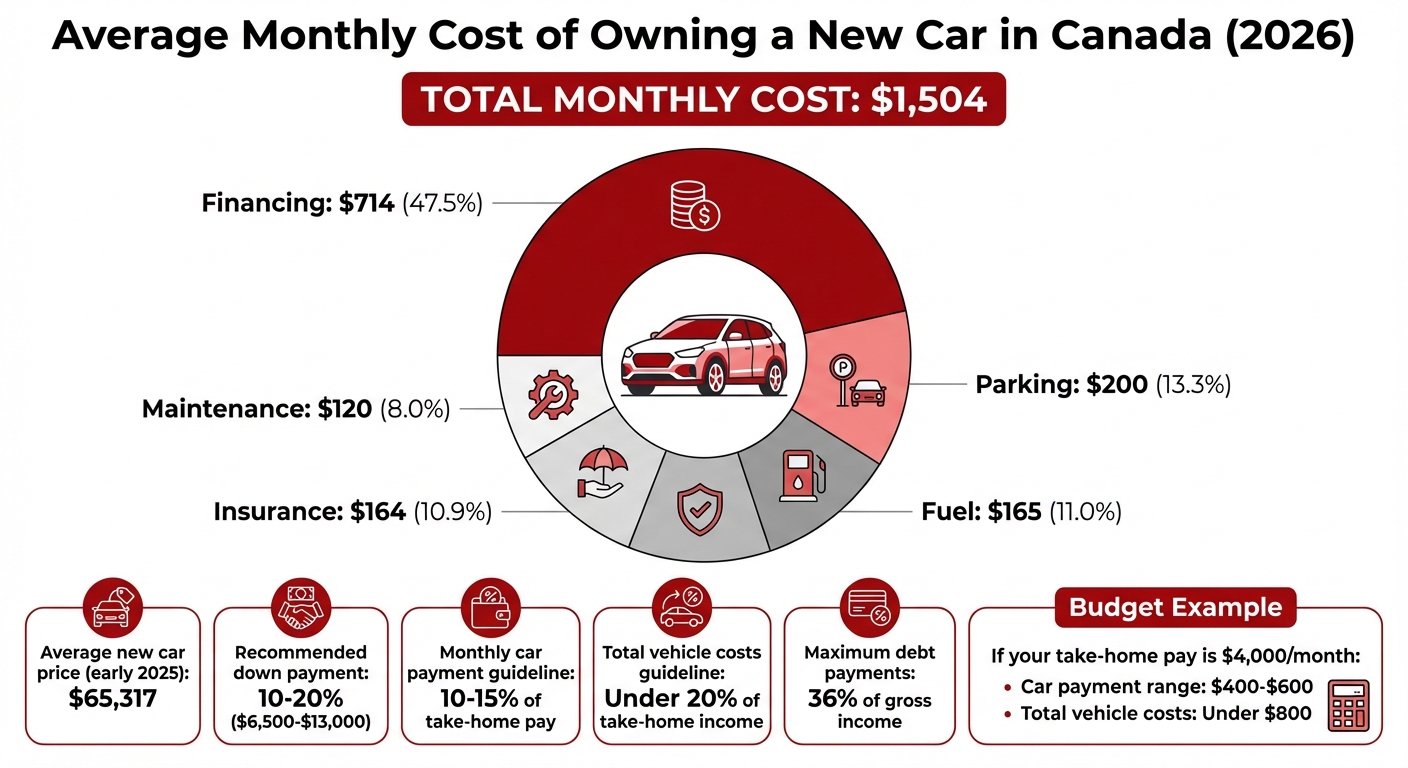
Average Monthly Cost of Owning a New Car in Canada 2026 Breakdown
Set a Budget You Can Afford
Keep your monthly car payments within 10–15% of your take-home pay. For instance, if your post-tax income is $4,000 per month, aim for payments between $400 and $600. When you add insurance, fuel, and maintenance, your total vehicle costs should stay under 20% of your take-home income.
A down payment of 10–20% can help reduce your loan and the interest you'll pay over time. With the average price of a new car in Canada hovering around $65,317 as of early 2025, this means setting aside $6,500 to $13,000 upfront. Also, ensure your total debt payments - including your car loan - don’t exceed 36% of your gross income.
Include All Ownership Expenses
The sticker price is just the start. To truly understand affordability, you need to factor in all the extra costs that come with car ownership. These include financing interest, insurance, fuel, maintenance, and provincial taxes. By 2026, the average monthly cost of owning a new car in Canada is estimated at $1,504, broken down as follows: financing (~$714), fuel (~$165), maintenance (~$120), insurance (~$164), and parking (~$200).
Insurance prices vary widely by province. Make sure to get quotes for the specific models you're considering. In Ontario, new drivers might face annual premiums ranging from $3,000 to $7,000.
Fuel expenses depend on your location and driving habits. To estimate your monthly fuel costs, multiply your expected mileage by the vehicle’s fuel consumption rating (L/100km) and your local gas price. Don’t forget to include provincial registration fees and applicable taxes like GST, HST, or PST, which can add thousands to your total cost.
Being aware of these ongoing expenses will give you an edge when negotiating or comparing offers.
Find Transparent Pricing and Discounts
Invoice vs. MSRP
The MSRP (Manufacturer's Suggested Retail Price) is the sticker price automakers recommend dealers charge for a vehicle. On the other hand, the invoice price represents what the dealer pays the manufacturer. Understanding the difference between these two prices can give you an edge when negotiating.
What many buyers don't know is that a dealer's actual cost is often lower than the invoice price. This is due to holdbacks and dealer allowances. Automotive journalist Jil McIntosh explains:
"The invoice price is the basic charge for the dealer to buy the vehicle from the manufacturer. From here... the dealer can charge more than the invoice price, to cover the cost of running the dealership and to earn a profit."
Holdbacks, which are typically 1% to 3% of the MSRP, reduce the dealer's true cost even further.
With tools like Price Driven, you can access free discount reports that reveal the actual dealer price of the vehicle you're considering. These reports also include current promotions and incentives, allowing you to negotiate from a more informed position. For example, Michael S., who recently bought a 2024 Ford Escape, shared:
"Knowing how much discount there is, helps with negotiating the price."
By combining transparent pricing with seasonal promotions or government rebates, you can secure a better deal.
Look for Promotions and Rebates
Timing plays a big role in finding discounts. Late summer and early fall are prime times to shop, as dealerships focus on clearing out older models. Similarly, December and January often bring aggressive pricing as dealers aim to meet year-end sales quotas, especially during the holiday season when buyers are less active.
In addition to seasonal sales, government rebates - such as provincial EV incentives - can often be stacked with dealer discounts. Download Price Driven's free discount report to uncover available incentives. Customers using these tools have saved an average of over $1,200 on their vehicle purchases as of 2026[16,17]. Lucas H., who purchased a 2025 Kia Seltos, said:
"Price Driven made buying my first new car so easy! The transparent pricing gave me confidence, and the pre-negotiated deal saved me hundreds."
Shopping on weekdays instead of weekends can also work to your advantage. Weekdays are often slower, giving you more time and attention from sales staff in a less rushed environment. Additionally, keep an eye on dealership websites for end-of-month or end-of-quarter deals, when sales teams are eager to hit their targets.
Shop Around and Negotiate Effectively
Compare Offers from Multiple Dealerships
Reach out to 3–4 dealerships via email and request quotes that include the full out-the-door price. This means getting the MSRP along with all options, fees, and taxes, so you can make a clear, apples-to-apples comparison. Taking this step allows you to evaluate offers at your own pace and even use competing quotes to your advantage.
In six Canadian provinces - Ontario, Quebec, British Columbia, Alberta, Saskatchewan, and Manitoba - dealerships are legally required to advertise all-in pricing. This regulation helps you avoid surprise fees and makes comparisons easier.
Once you’ve narrowed down your options, dig into each dealership’s reputation. Instead of relying solely on Google reviews, check community groups or Facebook forums for honest feedback. Also, consider separating your test drive from the negotiation process to keep things focused. Automotive journalist Stephanie Wallcraft offers a key piece of advice:
"To get the best deal, you need to be willing to walk away."
If you’d rather skip the back-and-forth altogether, the next section offers an alternative with pre-negotiated pricing.
Use Pre-Negotiated Pricing
If the idea of haggling sounds stressful, services like Price Driven can simplify the process. For a $99 fee, they secure pre-negotiated deals with partner dealerships, giving you a discounted price upfront. All you need to do is show up and sign the paperwork. On average, customers save over $1,200 using this service, with typical savings starting at $700+.
The process is easy: choose your vehicle, pay the service fee, and head to the dealership with your pre-arranged price. This approach cuts your time commitment from hours of negotiation to just about 10 minutes. If you’re still interested in negotiating yourself, you can use Price Driven’s free discount reports. These reports reveal the dealer invoice price and any hidden incentives, giving you the upper hand when it’s time to negotiate.
Buy at the Right Time
After gathering quotes and considering pre-negotiated pricing, timing your purchase can make a big difference. The end of the month, end of a quarter (March, June, September, December), or the end of the year are great opportunities to save. During these periods, sales reps are often motivated to close deals to hit their targets. Stephanie Wallcraft explains:
"If you shop toward the end of a month, end of a quarter... or end of the year, a sales representative may be more motivated to give you a better deal to get the sale on the ledger."
Weekdays are another smart time to shop since dealerships are typically less busy. This allows the sales team to give you more personalized attention without the weekend rush.
sbb-itb-20f5d75
Arrange Financing and Trade-In Your Current Vehicle
Compare Financing Rates
Before committing to any agreements, consider securing a pre-approved loan from your bank or credit union. This step not only gives you a clear benchmark for interest rates but also strengthens your negotiating power when discussing financing options with a dealer. Credit unions, in particular, often provide lower rates and more personalized service.
Your credit score plays a crucial role in determining your interest rate. A higher score can result in better loan terms, while a lower score might mean higher costs or even loan rejection. To prepare, check your credit report early and dispute any errors you find. Lenders generally prefer a debt-to-income ratio of 36% or less for loan approvals.
When negotiating, focus on the total out-the-door price of the vehicle, which includes the MSRP, options, fees, and taxes. Dealers might try to lower monthly payments by extending the loan term, but this often increases the total interest you pay over time. Keep your attention on the overall cost rather than just the monthly payment.
Once you’ve arranged your financing, it’s time to focus on getting the best value for your current vehicle.
Get Your Trade-In Appraised
Start by determining your vehicle’s fair market value using tools like Canadian Black Book or Kelley Blue Book before stepping into a dealership. Your trade-in value depends on factors such as the car’s mechanical and cosmetic condition, market demand for your model, and its history - especially any accidents or major repairs.
To potentially increase your trade-in offer, address minor repairs, clean and detail the interior, and gather all maintenance and warranty records. Visiting two or three dealerships for competing trade-in evaluations is also a smart move, as it ensures you’re not settling for the first offer.
When negotiating, always agree on the purchase price of your new car before discussing the trade-in value. Keeping these transactions separate helps avoid dealers blending a lower trade-in offer into the final numbers. Additionally, in most Canadian provinces, sales tax is only applied to the difference between the price of the new car and your trade-in value, which can result in considerable savings.
Complete Your Pre-Purchase Checklist
Test Drive and Check All Features
Set aside 20 to 30 minutes for a test drive, though some experts suggest going up to an hour to get a thorough feel for the vehicle [28,29]. Before hitting the road, inspect the cold engine for any signs of leaks or damage and check the tire tread. Make sure all lights - hazards, turn signals, and high beams - are functioning properly.
Test out all the features, from seat adjustments to connectivity options, to ensure they meet your needs. If you have kids, bring their car seats to check if the connectors are easy to access. You can also bring along items you frequently transport, like a stroller or hockey gear, to confirm they fit comfortably in the trunk.
Check that the air conditioning cools within 15–20 seconds and that heated seats or the steering wheel warm up quickly. During the drive, test the car's acceleration on highway on-ramps to ensure it has enough power for merging. Pay attention to any unusual sounds, vibrations, or pulling when braking [28,29].
"A traditional test drive only lasts up to an hour, but can make or break how happy you are with your vehicle purchase." - Driving.ca
It’s a good idea to separate the test drive from price negotiations. Bring a companion to help assess the rear-seat comfort and spot any issues you might miss. Once you’re satisfied with the car's performance and comfort, shift your focus to understanding the associated costs.
Check All Costs and Fees
Take a close look at your purchase agreement to ensure it reflects all-in pricing, including mandatory taxes and any optional add-ons. Provincial regulations require dealers to disclose the full price, though this doesn’t always include sales tax or registration fees.
| Fee Type | Status | Estimated Cost |
|---|---|---|
| Air Conditioning Tax | Mandatory | $100 |
| Tire Levy | Mandatory | $20–$30 |
| OMVIC/AMVIC Fee | Mandatory | $10–$12.50 |
| Admin/Doc Fee | Negotiable | $500–$800 |
| VIN Etching | Optional | Varies (can be DIY) |
| Nitrogen Tires | Optional | Varies (often unnecessary) |
For new vehicles with air conditioning, a federal excise tax of $100 applies. Provincial tire levies generally range from $20 to $30, and regulatory fees like OMVIC in Ontario ($12.50) or AMVIC in Alberta ($10) are mandatory. If you’re considering a luxury vehicle priced over $100,000, be aware of the federal luxury tax. This is calculated as either 10% of the total taxable amount or 20% of the amount exceeding $100,000, whichever is lower.
Optional add-ons like nitrogen-filled tires, VIN etching, or rustproofing can inflate your bill. If you didn’t request them, ask for their removal. The dealer administration fee is often negotiable, so it’s worth pushing back on this cost. Before finalizing the deal, get insurance quotes for the specific model and trim level to avoid surprises.
"A dealership cannot surprise you with any fees once the transaction is under contract." - Stephanie Wallcraft, Professional Freelance Writer, Driving.ca
Keep in mind that vehicle purchases in Canada are final - there’s no cooling-off period once you sign the bill of sale [28,18]. Ensure all costs are clear and verified before proceeding.
Get Support Before Finalizing
Navigating the car-buying process in Canada can be tricky, but expert advice can make a big difference. Professionals can help you review purchase agreements to identify hidden fees or unclear financing terms. This extra layer of scrutiny ensures transparency and consistency throughout the process.
Services like Price Driven offer premium support, including invoice price reports that reveal what the dealer paid for the vehicle. This information can give you a stronger position during negotiations, helping you avoid inflated quotes. On average, customers using professional car-buying support save over $1,200 [26,7].
"Understanding the car buying process in Canada transforms what could be a stressful task into an empowering experience." - Price Driven
Before signing, have an expert review your purchase agreement and financing terms. Compare the dealership’s financing rates with pre-approved loans from banks or credit unions to secure the best deal. Double-check that the invoice reflects the negotiated price, including MSRP, freight/PDI, admin fees, and taxes. Don’t focus solely on the monthly payment - it’s the total cost that matters.
"Being informed is your best negotiation tool, and with careful thought and research, you'll find a vehicle that not only fits your needs but also your budget." - Price Driven
Conclusion
Every step in this checklist contributes to keeping your car purchase within budget. By following a clear plan - setting a realistic budget that accounts for all ownership costs, researching dealer invoice pricing, and comparing full out-the-door offers - you can avoid overspending.
Price Driven’s free discount reports provide insights into dealer-level pricing, hidden incentives, and discounts. For those looking for even more savings, their $99 premium service offers pre-negotiated pricing, with customers typically saving over $700.
"Price Driven made buying my first new car so easy! The transparent pricing gave me confidence, and the pre-negotiated deal saved me hundreds." – Lucas H., Kia Seltos Buyer
Before you finalize your purchase, double-check that the purchase agreement includes all fees and charges. Don’t hesitate to negotiate costs like documentation fees (which can range from $300–$800) or decline unnecessary add-ons.
FAQs
What’s the best down payment for a new car in Canada?
When buying a new car in Canada, aiming for a down payment of at least 10% is a good rule of thumb. While many lenders set this as the minimum requirement, putting down more can work in your favour. A higher down payment reduces your monthly payments and cuts down the total interest you’ll pay over the life of the loan. Plus, it can give you more financial breathing room as you manage your loan over time.
How do I estimate my real monthly cost to own a new car?
To figure out your monthly expenses for owning a new car, you’ll need to calculate the total cost of ownership (TCO). This includes everything: financing, insurance, fuel, maintenance, depreciation, and taxes. Start by adding up all these costs to get the yearly total, then divide that number by 12 to find your monthly estimate. For variable expenses like fuel and insurance, using average values can give you a clearer picture. This approach helps you budget more effectively and avoid surprises.
Which dealership fees are mandatory vs. negotiable?
In Canada, when buying a vehicle, some dealership fees are mandatory, while others can be negotiated. Mandatory fees include taxes like GST and PST, as well as regulatory charges - these are fixed and non-negotiable. Documentation fees, which usually range between $300 and $800, are also often required, though there may be room for negotiation in some cases.
On the other hand, negotiable fees include freight charges, dealer preparation fees, and optional extras like warranties or protection packages. To avoid unnecessary expenses, always ask for a detailed, itemized breakdown of all fees. This will help you spot areas where you can negotiate and potentially save some money.